December 5, 2025 Hello , Somehow, I missed the Disney movie about Mulan, a Chinese girl warrior, But I've heard it's good. Disguised as a man, Mulan joins the army to fight in place of her elderly father. The movie is based on an ancient Chinese folktale first written down in a 6th Century poem. At a similar time in history, early 7th century China,
of real-life woman warrior raised an army of 70,000 men and fought to bring down the Sui Dynasty. Princess Zhao of Pingyang played a major role in ending a reign of wasted resources and failed foreign conquest. Her initiative and courage laid stones in the
foundation of for what would become the largest and most powerful empire in the 7th Century World.
The Warrior Princess of the Tang Dynasty
Chinese Emperor Yang ruled the Sui Imperial Dynasty at the turn of the 7th Century, first uniting the North and South into a major dominion, then starting a public works project to extend the Great Wall of China and
and the empire's ancient Grand Canal system. Yang Sui ordered farmers, enslaved people and criminals to do the construction, and killing six million people who died of overwork and disease. He also ordered his armies, including conscripted soldiers to invade Korea and Vietnam.
Great Wall of China, photo thanks to Curiouscatontherun Losing bloody battle after battle and bankrupting China, his people began to criticize and complain. Bandit and rebel groups sprouted throughout the countryside. Peasant uprisings turned the aristocracy and literati again Emperor Yang. Li Yuan, a Sui general commanded an army that secured China's frontier, negotiating peaceful borders. His troops were loyal
and he had prestige as duke of Tang and governor of Taiyuan. Threatened by his growing power, in 617, the Sui emperor ordered Li Yuan's arrest and execution. The general had little choice but to revolt and it caught his daughter Zhao of Pingyang in a precarious situation. Zhao's husband Chai Shao served as one of the crown prince's bodyguard and the couple lived in the capital city
of Chang'an near the palace. They had become instant traitors to the empire and would be executed on sight. As they waited for dark to flee the city, they worried about being too conspicuous as a couple. Zhao said, as a woman, she could hide more easily and insisted Chai head out first. Zhao hid initially, then escaped to her family’s estate in Huxian province. She didn't wait for her father's or brothers' armies to protect her and it was clear to her why the peasants were rebelling. They dying starving. Opening her family’s grain reserves to the people gained her a loyal following. She sold her family's home and most of the land to buy weapons. We don't know if she learned negotiation from her father, or if it came to her naturally. She sent a servant to meet the farmers rebel leader on her behalf and persuade him
to bring his guerrillas to fight for her. Then she talked three former Sui army commanders and their men to join her resistance to the emperor.
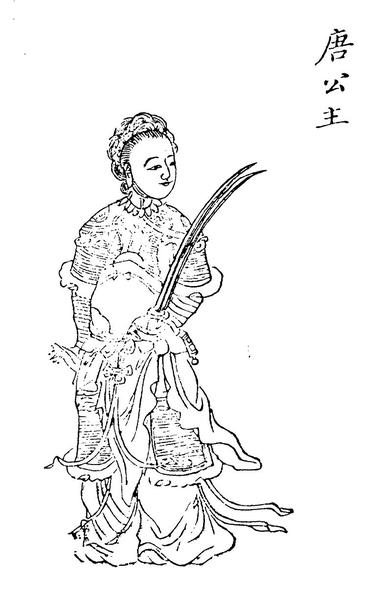
Sketch of Princess Pingyang, Wikipedia, public domain. Within months, Zhao led the combined forces to attack and capture the capital of Huxian province. There, she laid down the law. Her men would not rape and plunder. She whipped her soldiers into shape for battle and kept recruiting. She became a popular leader because she saw the people's hunger and provided food. One throwing bacon from the backs
of wagons and deploying soldiers in the streets giving away syrup. While her ranks grew, the Emperor Yang's forces underestimated her military strength because she was a woman. When they finally attacked, the 70,000 soldiers under Zhao's command defeated them soundly. She took her best 10,000 men and marched north to link up with her husband Chai and her brother Li Shimin who was in charge of one wing of her father's army. Zhao did not give up her command. As a general, she had her separate headquarters and her wing became known as the Army of the Lady. Li Yuan's
command crossed the Yellow River into the Chang'an region and the family forces converged to attack the Imperial palace at Chang'an (in modern day Xi'an). Zhao led one wing of the army assault, which succeed, driving the Sui from the city. General Li seized the throne in 618, declaring himself Emperor Gaozu, first ruler of the Tang
Dynasty.
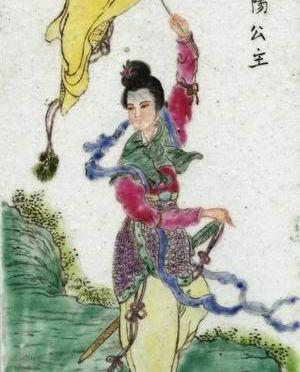
Princess Pingyang. Image: Sheroes of History. Emperor Gaozu was proud of his daughter and
grateful for her help conquering China. He appointed Zhao a military marshal and named her the Princess of Pingyang. Sadly, she never fought in another battle, dying in 623, and leaving two young sons. The cause of her death is lost to history, but her funeral made a lasting mark. Emperor Gaozu ordered a grand funeral fit for a military general and including military music. Some complained it wasn't proper for a band to play at a woman's funeral, but her father prevailed, saying, "As you know, the princess mustered an army that helped us overthrow the Sui dynasty. She participated in many battles, and her help was decisive in founding the Tang dynasty. She was no ordinary woman." Those word were preserved in Chinese literature to survive the centuries that have passed since Princess Pingyang's military success. Emperor Gaozu also named an important mountain
pass in Pingding county, "the Young Lady's Pass" to honor her. Historians say the Tang Dynasty was a high point in
Chinese Imperial civilization – trade and military might flourished along with art, music and poetry under the Tang Emperors who ruled for 300 years.
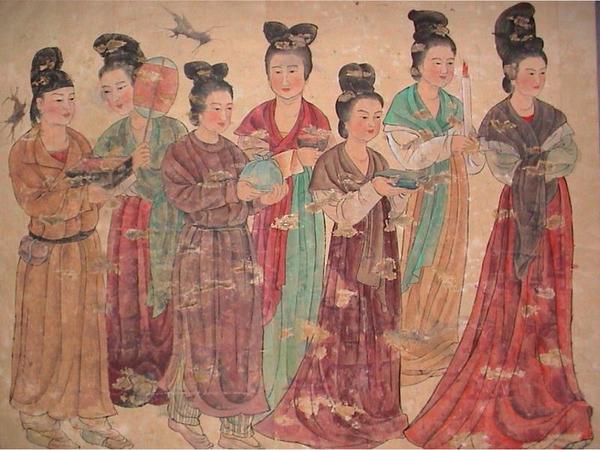
Tang Dynasty mural from Xian, China, photo thanks to freeimageslive.co.uk - Rodrigo Princess of Pingyang is the name Zhao is most commonly remembered by, though she doesn't fit with the popular modern view of princesses. In an era when girls, wives and mothers were much like bond servants, with no say over their lives, she took the initiative to raise an army and lead men into battle. Her compassion and courage were extraordinary for the time. Though she didn't live to see it, women gained some rights and freedoms at the peak of the Tang Dynasty. One of those was the right to remarry if widowed and divorce if agreed to by husband. A Tang Dynasty divorce agreement, discovered in Dunhuang, reads: "Since we cannot live together harmoniously, we had better separate. I hope that after the divorce, niangzi (a form of address for one's wife) can be as young and beautiful as before, and may you find a more
satisfactory husband. I hope that the divorce will not plant hatred between us in the future." Sounds pretty good, though the worst of the husbands would probably never agree to let their wives go. Still, an increment of freedom is better than none. I'm
guessing Zhao and Chai had a good marriage if they discussed together how they should flee Chang'an and Chai took his wife's advice. From what I could discover, he had no complaints about her career move. I'm sad to note the most common guess about the cause of death in the case of Princess of Pingyang is childbirth, a risk men need not fear. Despite the miracles of modern
medicine, this heartless killer continues to stalk women in our own century.
Like my article today? Forward this email to share with family and friends.
Sources https://en.wikipedia.org/wiki/Princess_Pingyang
Until next week...
This newsletter is a reader-supported publication. To support my work, consider becoming a paid subscriber.
Read
a great book? Have a burning question? Let me know. If you know someone who might enjoy my newsletter or books, please forward this e-mail. I will never spam you or sell your email address, you can unsubscribe anytime at the link below. To find out more about my books, how I help students, teachers, librarians and writers visit my website at www.MaryCronkFarrell.com. Contact me at [email protected]. Click here to subscribe to this newsletter. |
|
|