December 26, 2025 Hello , You probably know someone like me whose birthday is close to Christmas, maybe even on Christmas day. You're used to their perpetual whining about the unfairness of it. I'm not complaining as loudly as I used to. Like when my family purchased it's first stereo in 1965, and my parents started giving us kids a record album for
each birthday. After unwrapping Christmas music for several years in a row, I convinced my mom to see how unfair this was. Maybe if I'd gotten Snoopy vs the Red Baron, a hit around the world in 1966, I would have been happy to play the record all year long, like we did my sister's recording of Disney movie hits. But the only real salve when Christmas festivities overshadow your birthday celebration is similar griping and complaining from other hapless victims. And the stubborn hope that someday you will get your due. Like one girl who received the most amazing birthday present from Writer Robert Louis Stevenson!
I Never Know Where the
Research will Take Me
Annie Ide was born in Vermont in 1876, on Christmas Day. She may not have noticed the first few years, but the first time she saw another child ripping open presents in July, she knew
something was dreadfully wrong. She hated that she'd been born on Christmas Day and made sure everyone in the family knew she was cheated. Annie's father left Vermont for a stint as the US land commissioner in Samoa when she was fourteen. He struck up a friendship
with the famous author Robert Louis Stevenson. Stevenson had moved to Samoa two years before hoping the climate would ease his chronic respiratory illness.
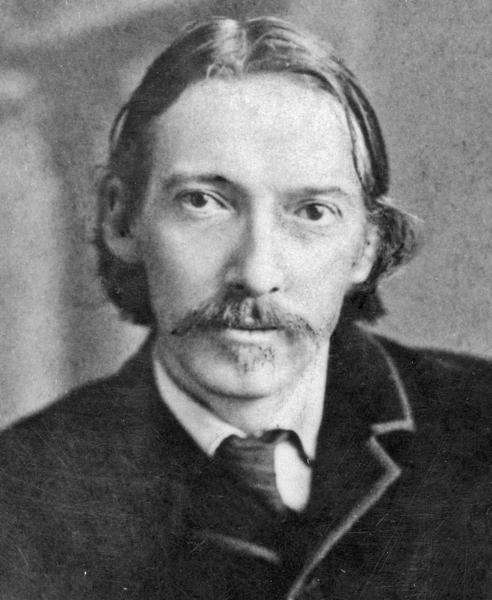
Portrait, Robert Louis Stevenson, 1887. Public domain. Probably missing his family, Henry
Clay Ide spoke of his children to Stevenson, including the story of how much Annie hated being born on Christmas day, how she longed for the attention, parties and presents other children got because their birthdays came at some boring time of the year. Stevenson felt her pain. Not wasting a moment he sat down and gave his birthday, November 13th, to Annie. A lawyer in his native
Scotland, he new the legalese to create a binding deed for the transfer of property.
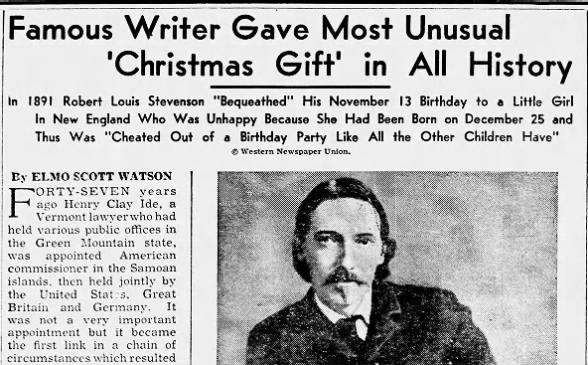
The Marcellus News, Marcellus, Michigan, December 22, 1938. Courtesy Newspapers.com
The document stated, in part: Considering that I, the said Robert Louis Stevenson, have attained an age when O, we never mention it, and that I have now no further use for a birthday of
any description... do hereby transfer to the said A. H. Ide, All and Whole of my rights and privileges in the 13th day of November, formerly my birthday...to have, hold, exercise and enjoy the same in the customary manner, by the sporting of fine raiment, eating of rich meats and receipt of gifts, compliments and copies of verse, according to the manner of our
ancestors. When November 13th rolled around that year, 1891, Annie, turned not 15, as scheduled, but one, celebrating her
first real birthday with a party, games, gifts, ice cream and a cake with one candle. Unfortunately, Annie’s mom died months later in the
spring of 1892. Henry Ide moved Annie and her sister TK Marjorie, from Vermont to Samoa.
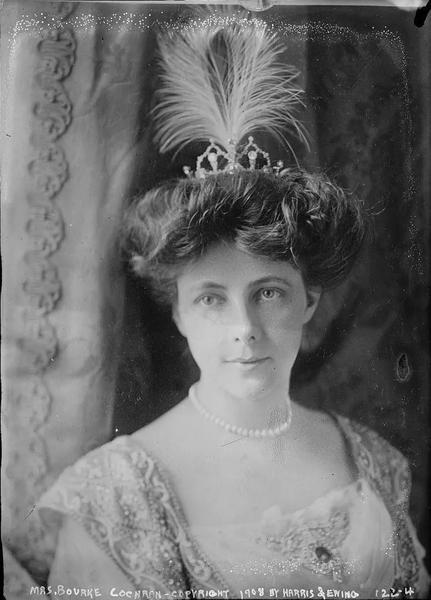
Annie Louisa Ide Cockran in 1908 from the Library of
Congress.
Crossing the ocean by steamship, the made a stopover in the long journey in Honolulu, where the family met Robert Louis Stevenson and traveled on to Samoa together. Annie and the author became friends and he held a feast to celebrate her birthday the next November at his home, Vailima. Native Samoans brought gifts of crafted mats, fans, and beads. They danced and sang.
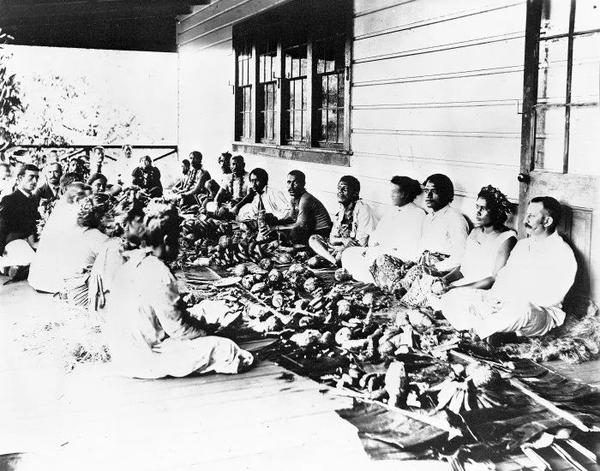
People seated around a feast which is laid out on a verandah at Robert Louis Stevenson’s House, Vailima, Samoa. (New Zealand National
Library)
Years later, in 1904 The Ladies Home Journal described the meal: "[They}] sat cross-legged on the ground, Samoan fashion, and the feast was laid on banana leaves, the native substitute for a tablecloth. Every edible luxury the islands afforded them – mangoes, guavas, taro,
coconuts, bananas, wild pigeons, shrimps, fish – all prepared with the skill for which every native chef is famous.“ Stevenson admired the Samoan culture
and people. His respect for their traditions gained him affection, acceptance in the native community. When he'd come ashore in Samoa, in 1889, the islands were in the midst of a civil war over succession to the Samoan throne. Behind the stand-off between rival chieftains was a three-way struggle for control between the colonial powers, Germany, the US and Britain, each of which had dispatched warships to the Samoan islands to protect it’s commercial interests. Stevenson brought his family to the islands, built a mansion in the village of Vailima, and quickly became embroiled in the political conflict. Drawing from his Scottish heritage, he saw how vulnerable the Samoa’s clan society was to foreign manipulation and took the side of the islanders against the colonialist. Famous for his fiction, Treasure Island, Kidnapped, Strange Case of Dr Jekyll and Mr Hyde, Stevenson now became a reporter and an agitator firing off letters to The Times in
London and publishing articles in magazines. His book, A Footnote to History: Eight Years of Trouble in Samoa about Samoan Civil War served as such a stinging protest against
existing conditions. Two European officials were recalled to the continent, and for a time Stevenson feared his own deportation. His passionate engagement
with the Samoan's circumstances earned Stevenson the nickname “Tusitala,” meaning “Teller of Tales,” among the native people. The man we most remember as the author of the swashbuckling Treasure Island, through his writing and action amplified the Samoans' voice and drew international attention to their struggle for independence.
Photograph of Robert Louis Stevenson’s Vailima household in Samoa. Left to Right: Joe
Strong, Auvea (a plantation hand), Mary Carter (Maid to Mrs. M. I. Stevenson), Mrs. M. I. Stevenson, Elena, Lloyd Osbourne, Arrick, Talolo, Robert Louis Stevenson, Austin Strong, Fanny Stevenson, Isobel Strong, Simi (Butler), Lafaele and Tomasi. Public domain. Annie Ide would celebrate one more birthday with Stevenson before her died December 3, 1894. Robert Louis
Stevenson was just forty-four years of age. Research published in 2000, postulated Stevenson might have suffered from hereditary haemorrhagic telangiectasia, explaining his chronic respiratory troubles, recurrent episodes of pulmonary hemorrhage and his early death. Annie Ide lived to be 68 years old. What happened to the November 13th birthday then? She had deeded it to her niece Anita Leslie King in December of 1933, who passed it on when she died to her six-year-old granddaughter Heather Finn, who plans to bequeath it to her
daughter, 10-years-old as of this writing. The family is seriously committed to celebrating Stevenson's birthday every year. According to the original deed, if they don't, the birthday will transfer to the President of the United States. As for Samoa, after its Second
Civil War, involving Germany, the United States, and Britain, the Samoan Islands were partitioned in 1899, becoming American Samoa and German Samoa. In 1967, American Samoa became self-governing with the adoption of a constitution, but remains seventeen non-self-governing territories of the United States.
Know someone with a Christmas Birthday? Forward this email. Share with family and friends.
Sources https://en.wikipedia.org/wiki/Robert_Louis_Stevenson
Follow me on social media
This newsletter is a reader-supported publication. To support my work, consider becoming a paid subscriber.
Read
a great book? Have a burning question? Let me know. If you know someone who might enjoy my newsletter or books, please forward this e-mail. I will never spam you or sell your email address, you can unsubscribe anytime at the link below. To find out more about my books, how I help students, teachers, librarians and writers visit my website at www.MaryCronkFarrell.com. Contact me at [email protected]. Click here to subscribe to this newsletter. |
|
|