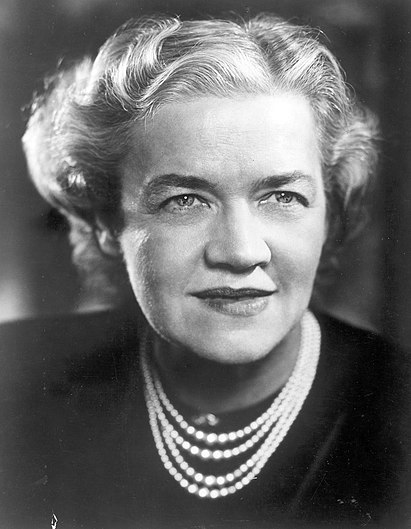
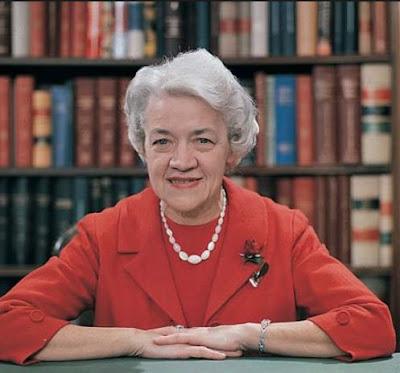
March 20, 2026 Hello , She was known as the quiet woman from Maine, the conscience of the Senate and the Cold War Warrior in Pearls. Margaret Chase Smith, a Republican from the State of Maine, became the first woman ever to serve in both the US House of Representatives and Senate. She served in Congress for thirty years from WWII to Watergate with a bipartisan voting record that spanned FDR's New Deal to support for the Vietnam War. She predicted she would be remembered less for her legislation and more because she was the first senator to condemn Joseph
McCarthy's tactics during the Red Scare. And she was right. Senator Smith denounced his Communist witch-hunt years before the country would call a stop to McCarthyism. “It is high time that we all stopped being tools and victims of totalitarian techniques—techniques that, if continued here unchecked, will surely end what we have come to cherish as the American way of life,” said Senator Smith.
This pioneering woman politician voted her conscience, no matter if she clashed with her fellow-Republicans.
She had the Good Conscience to Stand up to a Bully
On June 1, 1950, Senator Margaret Chase Smith stood in the US Senate to make a blazing 15-minute speech reminding Americans of their democratic principles. Her Declaration of Conscience also sent a direct message to Wisconsin Senator Joseph McCarthy, though she never mentioned him by name. There's a story that she bumped into McCarthy in the halls of government earlier that
day. “Margaret, you look very serious," he said. "Are you going to make a speech?”
“Yes," she told him. "And you will not like it."
Senator Margaret Chase Smith, US Senate Historical Office.
Public Domain. McCarthy had delivered an inflammatory speech four months earlier making accusations the 205 people in the State Department were secret communists. Smith herself was an ardent-anti communist but she'd been watching the results of McCarthy's
attacks, and she didn't like what she saw. Against the tide of Republican support in 1945, she voted against making the House Committee on Un-American Activities permanent. Bipartisan approval established it as a standing committee and went on investigating citizens and organizations for suspected of communist ties until 1975. Five years later, Senator Smith called out the repercussions. "The American people are sick and tired of being afraid to speak their minds lest they be politically smeared as ‘Communists’ or ‘Fascists’ by their opponents. Freedom of speech is not what it used to be in America. It has been so abused
by some that it is not exercised by others." Her colleagues in the Senate knew exactly who she thought was debasing the senate with this behavior. “Strength, the American way, is not manifested by threats of criminal prosecution or police state methods. Leadership is not manifested by coercion, even against the resented.” Margaret was born to a working class family in Skowhegan, Maine, in 1897. Her mother was a factory worker and he dad a barber. When she was 12, Margaret got a job at the five-and-dime store. After high school, she taught a year in a nearby one-room schoolhouse and coached basketball at Skowhegan High. After working as a substitute telephone operator, in 1919 at age 22, she was hired as the circulation manager at the local newspaper. She left the paper in 1928, and in 1930 married Clyde Smith, the paper’s owner. When he was elected to the House of Representatives in 1936, she moved with him to Washington DC and ran his congressional office. When her husband died in 1940, Margaret won his congressional seat in a special election.
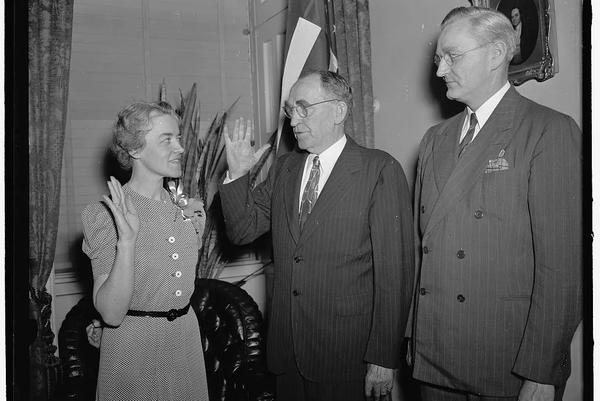
Margaret Chase Smith, wife of the late Rep. Clyde Smith, Republican, of Maine, is sworn in to fill the
vacancy left by her husband. Left to right, Smith, Speaker William Bankhead, and Maine Rep. James C. Oliver, Courtesy Library of Congress, Photographer: Harris & Ewing Margaret Smith won reelection four times to the House as a Republican, though she sometimes voted with Democrats. When a Maine senate seat opened up in 1947, she decided to run for it. She insisted she could do the job as well as any man, but not everyone agreed. “The little lady… is simply over-reaching herself,” wrote one reporter. She got push-back from the Republican Party, too, which refused to endorse her. The party backed Maine Governor Horace A. Hildreth, who was seen as more loyal. Smith won easily, becoming the first woman elected to both the House and the Senate. She toed the party line as an anti-communist and would later introduce a bill to outlaw the Communist Party, but she became disillusioned after McCarthy failed to provide any evidence of communists in the State Department. She denounced "the reckless
abandon in which unproved charges have been hurled from this side of the aisle"
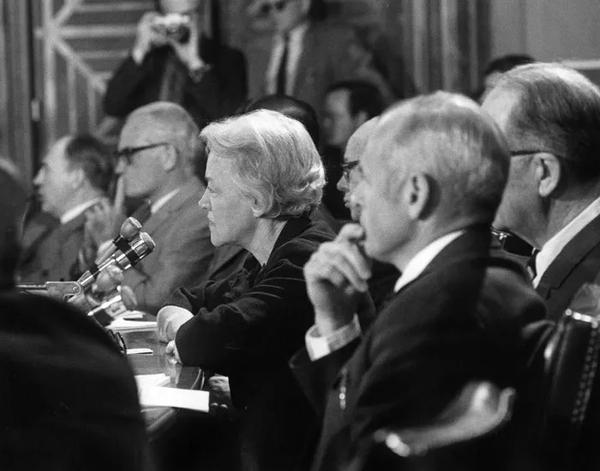
As the sole woman senator when she took office in 1949, Margaret Chase Smith lacked some of the conveniences provided to her male colleagues, such as a private
restroom.
U.S. Senate Historical Office
Senator Margaret Chase Smith gained national attention for her Declaration of Conscience, and yet, not until 1954, and the ruin of countless American lives did politicians have the courage to end McCarthy's lies and bully tactics. Through out her 32 years in Congress, Smith remained a
beacon of bipartisanship. “It is high time we stopped thinking politically as Republicans and Democrats about elections and started thinking patriotically as Americans about national security based on individual freedom," she said. “I don’t want to see the Republican Party ride to political victory on the four horsemen of calumny–fear, ignorance, bigotry and smear.” In the midst of Margaret's senate tenure, she
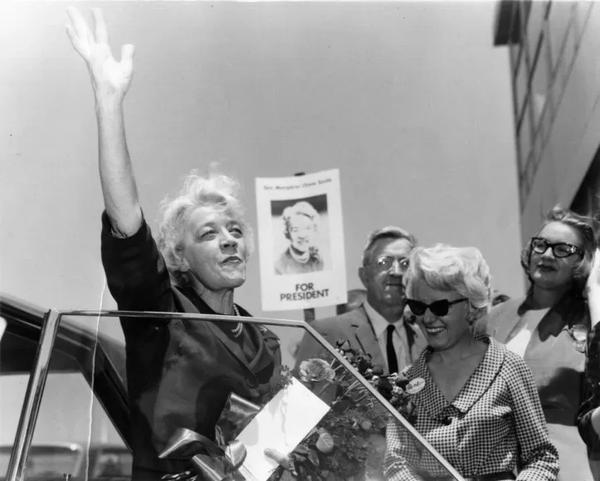
was mentioned numerous times as a possible vice presidential candidate, but demurred. She did take a run for the highest office in the land in 1964, when she became the first woman in the United States to be nominated for president on the floor of a national convention.
Margaret Chase Smith became the first woman to be placed in nomination for the presidency at a major political party's convention in 1964. U.S. Senate Historical
Office Singer Hildegard sang this song, Leave it to the Girls, for her campaign, which was brief and unsuccessful. Margaret represented Maine in the Senate until 1972, when she was defeated by Democrat Bill Hathaway, most likely, her support for the Vietnam War a factor as well as concerns about her health. It was the outbreak of the Korean War, less than a month after her Declaration of Conscience to the US Senate, that deflated Smith's effort to reign in McCarthy, according the Marvin Kalb, former moderator of The Kalb Report and a long-time journalist and author with a list of awards longer than my arm. “The
boiling intensity of the Cold War had the ironic effect of sidelining Smith and elevating McCarthy, whose anticommunist crusade only grew wider and stronger.” Margaret Chase Smith did help accomplish much for the good of the people of Maine and the country in her long political career, including voting for increased educational funding, civil rights, and the creation
of Medicare and Medicaid. She served as a charter member of the Senate Aeronautical and Space Committee. Former NASA administrator James E. Webb paid her high praise, saying the US wouldn't not have placed a man on the moon without her. You may remember at the
beginning I mentioned one of Margaret's monikers was the Cold War Warrior in pearls. She was indeed a hawk in congress her entire tenure and argued the US should use nuclear weapons against the Soviet Union. I'm glad she was outvoted on that! The MCSPC is grounded in the values of open communication, civility and a willingness to engage respectfully across differences and named to honor Margaret as a model of civil discourse and integrity.
The Center is dedicated to improving the quality of public dialogue, which suffers so much more today than in Margaret's time, we have to ask, did her words fell on deaf
ears? “Those of us who shout the loudest about Americanism, are all too frequently those who…ignore some of the basic principles of Americanism–the right to criticize, the right to hold unpopular beliefs, the right to protest, the right of independent thought.” To preserve our democratic rights, we'll have to find a way to come together and stand up to the bully.
Like my article today? Forward this email to share with family and friends.
Follow me on social media
This newsletter is a reader-supported publication. To support my work, consider becoming a paid subscriber.
Read
a great book? Have a burning question? Let me know. If you know someone who might enjoy my newsletter or books, please forward this e-mail. I will never spam you or sell your email address, you can unsubscribe anytime at the link below. To find out more about my books, how I help students, teachers, librarians and writers visit my website at www.MaryCronkFarrell.com. Contact me at [email protected]. Click here to subscribe to this newsletter. |
|
|