April 3, 2026 Hello , In 1974, Junior Congresswoman Barbara Jordan seized national attention with a powerful speech during the televised impeachment hearings of President Richard Nixon. The congresswoman from Texas spoke of "a President swollen with power" and a constitution written to "bridle" an Executive disdaining his duty to execute the laws of the land. A year after President Nixon resigned from office for his part in the Watergate scandal, Barbara Jordan warned: "We
forget quickly in this Country.... [Congress] must be the watchman in the night to protect our civil liberties and our constitutional freedoms."
Congresswoman with the Courage to Uphold the Constitution
It was a triumph of the United States Constitution that Barbara Jordan, a black woman from Houston, Texas, had a seat on the U.S. House Judicial Committee. Only ten years before, the
house had passed the 1964 Civil Rights Act to guarantee enforcement of Blacks' right to vote, outlaw segregation and prohibit racial discrimination. Jordan became a political pioneer in 1966 as the first African American since Reconstruction to be elected in the Texas Senate She moved the marker again in 1972 as the first Southern Black woman elected to the U.S. House of Representatives.
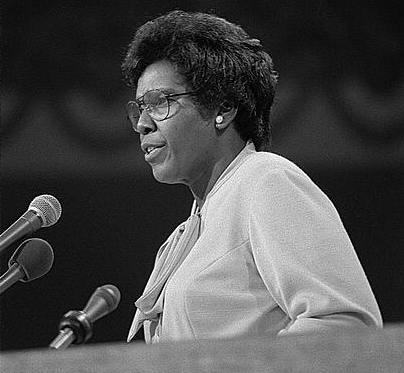
Barbara Jordan makes history again, the first Black woman to deliver a keynote address at the Democratic National Convention, 1976, New York City, courtesy Library of Congress, Public
Domain. The political terrain teemed with partisan strife in 1974, suffering no shortage of explosive headlines about civil rights, feminism and the aftermath of the Vietnam War. A presidential scandal and impeachment hearings also gripped the nation,
though the television news film featured mostly talking heads. Five men had been arrested for burglarizing the Democratic National committee headquarters in the Watergate office complex in Washington, D.C. Evidence suggested President Nixon had some connection to the crime. "Has the President committed offenses, and planned, and directed, and acquiesced in a course of conduct which the Constitution will not tolerate?" In Barbara Jordan's words, that was the question the House Judiciary
Committee would answer. In her first term representing Houston’s 18th district, she was mostly unknown outside of Texas. For 13 minutes on the hearing's second day, her words riveted prime time television viewers. “I am not going to sit here and be an idle spectator to the diminution, the subversion, the destruction of the
Constitution.” She insisted the American people wanted honesty and integrity in government, saying they did not want a "scoundrel" to lead them. She quoted James Madison's words at the Constitutional
Convention 188 years before. "A President is impeachable if he attempts to subvert the Constitution."
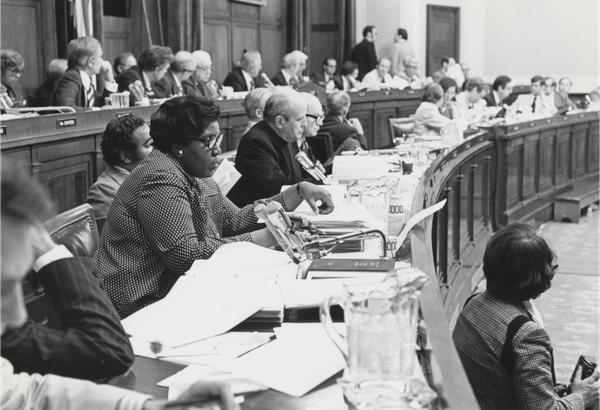
Rep. Barbara Jordan (TX) during the House Judiciary Committee Watergate hearings, courtesy U.S. House of Representatives Photography Office. "My faith in the Constitution is whole; it is complete; it is total," Representative Jordon proclaimed.
Though it had required some amending since ratification in 1788. “We, the people. It is a very eloquent beginning," Jordan said. "But when the document was completed on the seventeenth of September 1787, I was not included in that ‘We, the people.’ I felt somehow for
many years that George Washington and Alexander Hamilton just left me out by mistake. But through the process of amendment, interpretation and court decision I have finally been included in ‘We, the people.’” Barbara and her two sisters grew up in Houston's Third Ward, attending public schools in the era before Brown v. Board of Education desegregated schools. Their mother worked as a maid and their father in a warehouse. They raised their daughters in the Baptist church where Dad was the pastor and Mom a teacher.
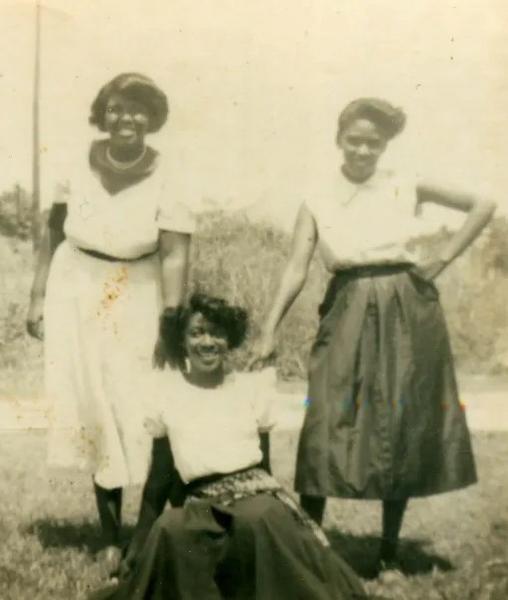
Young Barbara Jordan with her sisters. L to R: Barbara Jordan, Rose Mary McGowan, Bennie Craswell, c. 1950-1960s (African American Library at the Gregory
School)
Barbara and her sisters sang gospel music together and she recited poetry in church, which may have set her on the path of eloquent speech she used later
as a lawyer, state senator and congresswoman. Jim Crow segregation laws governed her daily life."There was a little plaque on the
bus near the back that said, 'colored' and when I'd get on, I'd have to go all the way back to that little plaque and I was passing empty seats all the time." But she did not let racist obstacles get in the way of her dream to leave Texas and become an attorney. She graduated from Boston University Law School in 1959 and in 1960, returned to Houston to start a private law practice.
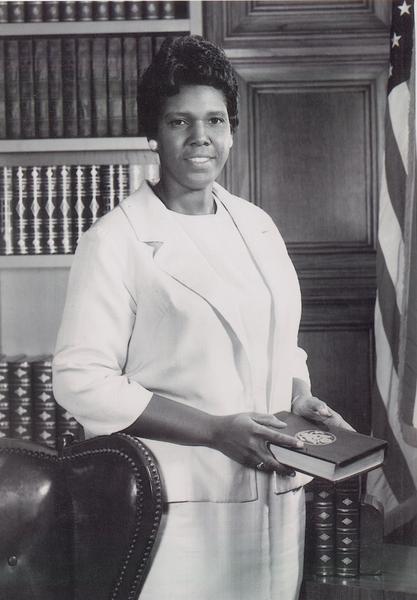
Official portrait of Barbara Jordan as Texas Senator, elected in 1966 and serving from 1967 to
1973. At 24-years-old, Jordan was one of only two black women attorneys in Texas. At 30, she became the first Black woman elected a Texas Senator taking
her seat among thirty white men. Despite a white supremacist attitude by fellow-senators, Jordan gained respect across party lines for her legal expertise, and a
reputation for discipline, legislative preparation, and the ability to navigate complex political situations. Blacks and women can thank Barbara for paving their way in
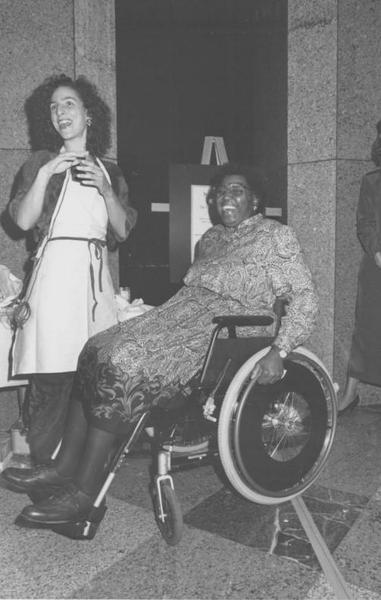
American politics. People who use wheelchairs can also look to her for inspiration. During her first year in Congress in 1973, Barbara developed multiple sclerosis. She served three terms in the House and went on to teach at the Lyndon B. Johnson School of Public Affairs at the University of Texas at Austin and advised two presidents on immigration reform.
The Barbara C. Jordan Archives, Texas Southern University Barbara Jordan described
her life's work as fighting for "an America as good as its promise." After the Watergate hearings in 1974, the House Judiciary Committee voted to approve three articles of impeachment against Nixon. He resigned months later. Barbara Jordan's speech is remembered by historians as a turning point in the Watergate
scandal. Watergate itself is remembered fondly as a time when Congress members of opposing parties, opinions, and political ambitions, united at a time of crisis to uphold the best interests of the American people. Will we ever again witness what can be
achieved when principles trump politics?
Like my article today? Forward this email to share with family and friends.
What comes after No Kings 3? Resistance against authoritarianism
goes BIGGER. Stop the Billionaire's Agenda Day of Action May 1st. Thousands of organizations across the country are calling for a mass day of action and a day of “No School, No Work, No Shopping” to disrupt the violent billionaire takeover of
our country and to put working families first. Because when the billionaires break every rule, it’s going to take more than a rally to stop them. Click the video. Turn on the sound. Indivisible Co-Founder Ezra Levin describes the plan to Minnesotans.
May 1st, workers, students and families will be marching, rallying, training, walking out and taking action together to demand: Tax the rich. So our families, not their fortunes, come first. No ICE. No war. No private armies to serve authoritarian
power Expand democracy, not corporate rule. Defend free and fair elections. Get involved here: https://www.mobilize.us/surj/?tag_ids=29741
Follow me on social media
This newsletter is a reader-supported publication. To support my work, consider becoming a paid subscriber.
Read
a great book? Have a burning question? Let me know. If you know someone who might enjoy my newsletter or books, please forward this e-mail. I will never spam you or sell your email address, you can unsubscribe anytime at the link below. To find out more about my books, how I help students, teachers, librarians and writers visit my website at www.MaryCronkFarrell.com. Contact me at [email protected]. Click here to subscribe to this newsletter. |
|
|