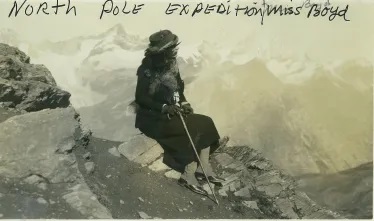
April 17, 2026 Hello , Louise Arner Boyd happened upon the opportunity of a lifetime. She recognized it and had the courage to seize it. I don't know if she
read Robert Frost's poem, but the famous last lines would have rung true for her. I took the one less traveled by,
And that has made all the difference. Heiress to a family fortune, Louise lived an unusually active life for a woman of the 1920s in the San Francisco area. A patron of the arts, socialite and European traveler, Louise also ran her father's investment company and in her later years would act as an agent for the US Army in WWII. Her life diverged not in a wood, but in one of the most bitter and extreme landscapes on earth. She'd set course on a pleasure boat seeking excitement, adventure and knowledge, then made a choice that forever changed the direction of her life and created
a legacy that remains valuable for us today. Content warning: polar bear hunting photo
From Big Game Hunter to Self-taught Scientist and Polar Explorer
When
Louise Arner Boyd's was just sixteen, the first of several tragedies struck her family. Wealth doesn't salve grief, but it allows life to go on in style. The girl cruised
Europe with her parents, took the train to New York City for shopping and enjoyed the social life in the Bay Area. In addition, she stepped up to take over the Boyd Investment Company at age 19, when her parents fell ill. She passed on marriage and family the traditional women's roles expected of her.
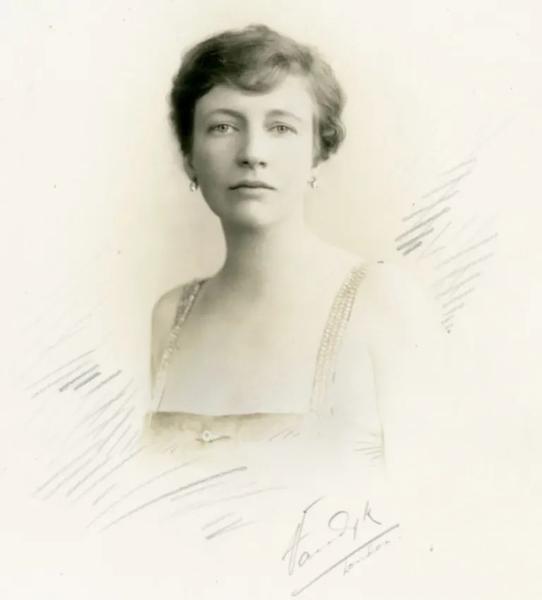
Louise Arner Boyd. Courtesy Marin History Museum. In 1919, Louise and friend bought an expensive limousine in New York and with her chauffeur, made a transcontinental trip back to California. They traveled what would later become US 10, US 20 and US 30, at that time mostly unimproved roads with no signs and few if any motels or hotels. Arriving at the California border near Fallon, Nevada, she wrote in her diary the chauffeur had to deal with a lost headlight “mud flats and quicksand getting into Fallon” on what barely
passed for a road. “Off the road," she wrote, "you were a goner!” Several years later, Louise outfitted
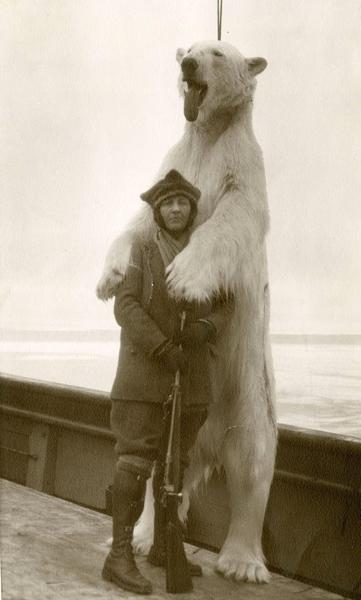
a ship for a cruise to Franz Josef Land, a Russian polar archipelago, the first woman to lead a trip to the Arctic. On board came a California society friend, a Spanish count and countess and bottles of Champagne. The voyage made world headlines, but it will make you absolutely sick. It was a different era. A time when big game hunting was a celebrated endeavor and before the polar bear became a protected species. Louise took scenic, as well as trophy photographs. The group reportedly killed 29 polar bears. After the trip, Louise had a change of heart and didn't kill any more of the animals. I think the rest of her story is worth reading. The scientific data she gathered on subsequent trips helps scientists today calculate climate change.
Louise Arner Boyd, a pioneering Arctic explorer from California, with a dead polar bear in 1926.
Living in California, Louise never saw ice and snow until she was an adult, but the far north fascinated her from the time she was a child. She loved to read about the daring polar explorers, their triumphs, but also the tragic and disastrous expeditions that excited rumors of cannibalism. Polar explorers were the heroes of the day, and Louise followed the controversy about whether Frederick A. Cook or Robert E. Peary first reached the north pole. Two years later she was riveted to news about the race to the South Pole between Roald Amundsen and Robert Falcon. While Louise could only read of the polar
adventures, she and her two older brothers had plenty of adventure at home including horseback riding, hunting and hiking in Northern California. She idolized her brothers John and Seth. A rambunctious girl, she tried to follow them everywhere and do everything they did.
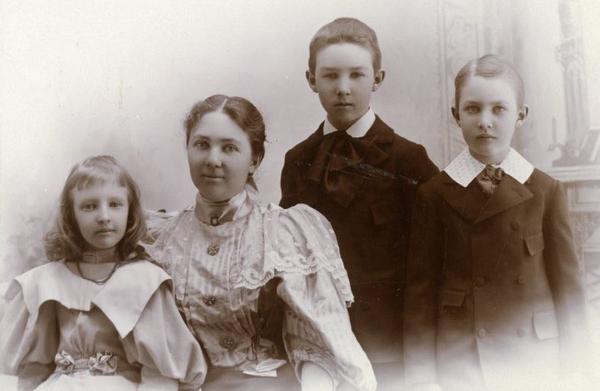
Louise Arner, Louise, John and Seth Boyd, ca. 1895, Marin History Museum.
Louise lived a privileged life in a close-knit family, her father a gold miner who struck it rich, her mother an East Coast, upper-crust woman. They
divided time between their ranch at the base of Mount Diablo and their Maple Lawn estate in San Rafael. It all changed one morning in August 1901, when Seth didn't show
up for breakfast. He had died of heart failure at only 17. Then eight months later, Louise's older brother John also died of an apparent heart attack. Within five years Louise's parents began to suffer poor health and died within a year of each other. At age 32, Louise became the sole heiress to a $3 million fortune (39-million today). She continued the refined life she'd been born to, hosting charity benefits at her Maple Lawn, entertaining noteworthy guests, attending parties and touring Europe with friends. People told her the far north was no place for a women. She didn't listen. “The charm and infinite diversity of the Arctic is its own reward. I have got the Arctic lure and will certainly go North.”
In the summer of 1928, two years after Louise's game hunting trip to Greenland, she again provisioned a ship and prepared to set sail from the far northern Norwegian city of Tromsø. Then she heard news that her childhood hero Roald Amundsen and his crew had vanished while searching for another explorer. "How could I go on vacation when those 22 lives were at stake," she said later. "I wanted to do something of which I [could] be proud." Louise offered her hired ship, provisions and crew to the Norwegian government to help find Amundsen and his French crew, but only if she could go along. Officials agreed and she became a critical part of the desperate rescue mission launched by six European countries. Tragically, they found no trace of Amundsen, but at the end of summer-long search, the Norwegian and French governments decorated Louise for courage and stamina. And she discovered
a greater purpose, exchanging tourism for scientific exploration.
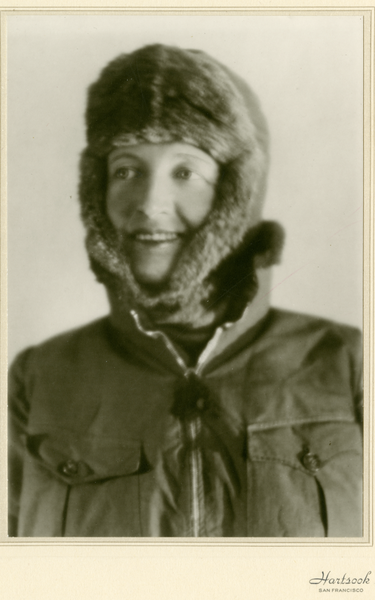
Louise models her arctic exploration gear for a San Francisco photographer, sometime in the 1930s or 1940s. Photo: Marin History Museum. Louise had no formal education beyond secondary school. But she was incredibly curious, a quick study and sought out experts to learn from, like photographer Ansel Adams and California Academy of Sciences botanist Alice Eastwood. She developed a reputation for identifying the best
scientists for specific situations. Basically self-taught, this pioneering polar scientist mapped uncharted regions of Greenland, filmed and photographed topography,
sea ice, glacial features, and land formations, measured ocean depths, and collected plant specimens.
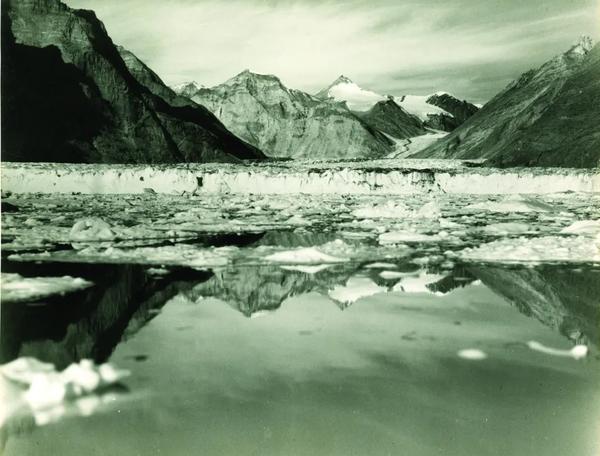
A Louise Boyd photograph of Nordenskiold Glacier in Franz Josef Fjord, then and now, one of
the most remote and unforgiving places on earth. 1931. Photo: Marin Historical Museum From 1930-1941, Louise organized, financed, and led six scientific
expeditions to East Greenland, Franz Josef Land, Jan Mayen Land, and Spitsbergen, enduring extremely brutal conditions, temperatures so cold one mustn't expose any skin for more than a couple seconds. "I revel in the cold," Louise said. "I'm reproached sometimes for wearing out the crew but they haven't suffered yet. There is never any hardship in doing what you're interested in." Cold wasn't her most difficult challenge. "The greatest handicap I have is being a woman which caused many to look upon me as not worthy to be included in the scientific world in many cases I have had far more actual experience than those so rated
scientists" In the beginning research scientists happily accepted her credentials willingness to spend her money on the expedition, but once aboard ship, some of the disparaged her in private eroding her leadership.
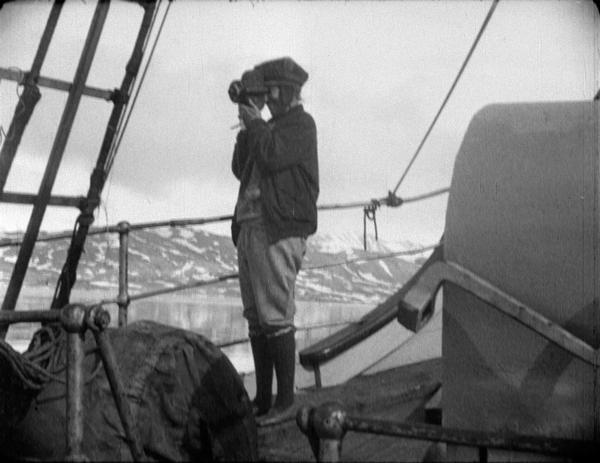
Louise Arner Boyd on deck with a camera. National Archives Though men openly told her that her work in the Arctic would not be taken seriously, she used cutting-edge methods, including taking the first deep-water echo sounding surveys the sea floor. She pioneered the use of Photogrammetry, using high-quality aerial photos to document the glacial landscape and created detailed maps of the region. "I load the cameras on board ship in a very small dark room," she said, "during field work I use a light proof changing bag of my own
devising." Processing her own negatives on shipboard gave her immediate scientific results. She discovered a glacier in Greenland, a new underwater bank in the Norwegian Sea and many new plant species. “Determination and persistence brought me to the position I achieved, she said.”
A prolific photographer and cinematographer who shot thousands of photos and thousands of feet of film
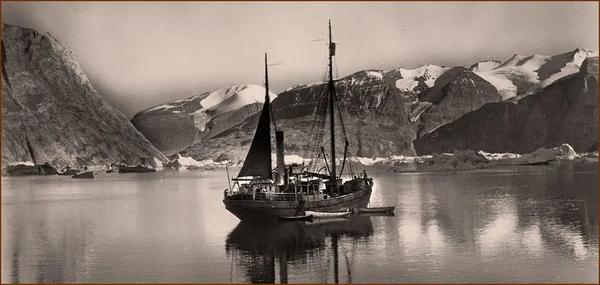
on her voyages, Louise Arner Boyd took this photo of her ship Veslekari anchored at Ice Fjord in eastern Greenland. On her last scientific voyage in 1941, the US Army secretly enlisted Louise to use her knowledge in search of possible military landing sites. Without the knowledge of her captain and crew she used her deep water-echo soundings. Also during her covert mission, she resolving critical radio transmission
problems that had plagued operations in the Arctic for decades. The Department of the Army sent a certificate praising Louise for
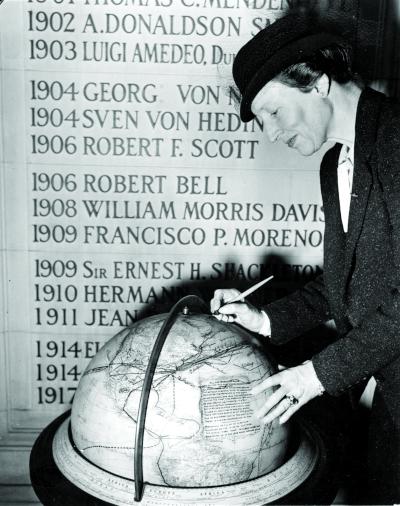
“exemplary service as being highly beneficial to the cause of victory.” The American Geographical Society elected Louise a member and she became the first woman to autograph their explorers globe, which recognized her as a scientist.
In 1938, Boyd was asked to sign the Fliers and Explorers Globe that today holds the signatures of
Charles Lindbergh, Amelia Earhart, and Neil Armstrong. (Courtesy Joanna Kafarowski)
Today as ice shelves erode, glaciers melt and water tables rise this pioneering woman's data helps scientists calculate climate change. Her data is still cited by scientists in the fields of geology, geomorphology, oceanography and
botany.
But it was the unique beauty of the polar regions that captivated Louise, sparked her curiosity and continued to lure her
back. Far north, hidden behind grim barriers of pack ice, are lands that hold one spell-bound,” she wrote in 1935's The Fiord Region of East Greenland. “Gigantic imaginary gates, with hinges set in the horizon, seem to guard these lands. Slowly the
gates swing open, and one enters another world where men are insignificant amid the awesome immensity of lonely mountains, fiords and glaciers.” Years after Louise retired from polar exploration, she marked another first for women. Chartering a plane in 1955, she returned to the Arctic one last time. "North, North, North, we flew," Louise said. "Then, in a moment of happiness which I shall never forget, our instruments told me we were there. Directly below us, lay the North Pole!" Like my article today? Forward this email to share with
family and friends.
Sources https://www.pbs.org/wnet/americanmasters/louise-arner-boyd-first-woman-lead-arctic-expeditions-wetprz/14106/
Follow me on social media
This newsletter is a reader-supported publication. To support my work, consider becoming a paid subscriber.
Read
a great book? Have a burning question? Let me know. If you know someone who might enjoy my newsletter or books, please forward this e-mail. I will never spam you or sell your email address, you can unsubscribe anytime at the link below. To find out more about my books, how I help students, teachers, librarians and writers visit my website at www.MaryCronkFarrell.com. Contact me at [email protected]. Click here to subscribe to this newsletter. |
|
|