April 24, 2026 Hello , This story caught my eye after I spent last weekend visiting my daughter in Los Angeles. While I was there, I didn't think to check out the site of the original Spanish settlement, a ten-block area in central Los Angeles. There's a National Parks Historical Monument at the original plaza. One of the earliest woman to
legally own property in the area that is now Los Angeles County was María Rita Quintero Valdés de Villa. Her ranch land had belonged to Native people before the Spanish arrived. Then Mexico took it from Spain and the United States took it from Mexico. In one lifetime, extraordinary political change fundamentally altered the land, its people and culture.
Meet the Woman in Charge when Beverly Hills was a Cattle Ranch
Wilshire Boulevard, one of the major streets through the city of Beverly Hills, California, was once a trail trod by Indigenous people. The neighborhood where multi million-dollar homes and upscale boutiques now sprawl over rolling hills, was once free range for cattle. María Rita Quintero Valdés de Villa witnessed the start of this transformation. She didn't choose to live her life among layers of colonialism in Los Angeles. The Afro-Latina bloomed where she was planted. With intelligence, strength and courage she owned and operated a 4500-acre ranch while navigating personal tragedy and political change.
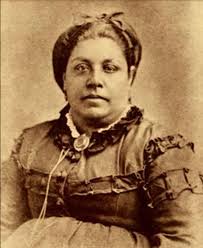
Portrait of Mariá Rita Quinteros Valdez de Villa, born 1791 in Los Angeles. In the mid-1700s, Spain’s empire in the Americas, Nueva España, stretched from South America north to what is today the U.S. Southwest. But Russian fur traders threatened, moving south along the Pacific Coast and likewise, Britain was empire building. Spain sent expeditions to current-day California to fortify its
grasp.One led by Don Jose Gaspar de Portolà in 1769-70, laid the groundwork for Spain’s colonial missions and secular towns like El Pueblo de los Angeles founded in 1781, which has become the City of Los Angeles. María Rita was born in El Pueblo de los Angeles ten years later May 21, 1791. Her maternal grandparents, Luis Quintero (who's father had been an enslaved black
man) and his mulata wife Maria, were one of the eleven families recruited by the Spanish government to found Los Angeles. Spain enlist families in today's northern Mexico, promising them land, animals, seeds and tools and a bright future. For landless workers this was an opportunity to leave the caste system. Though after crossing the dangerous Sonora desert, settlers would found a
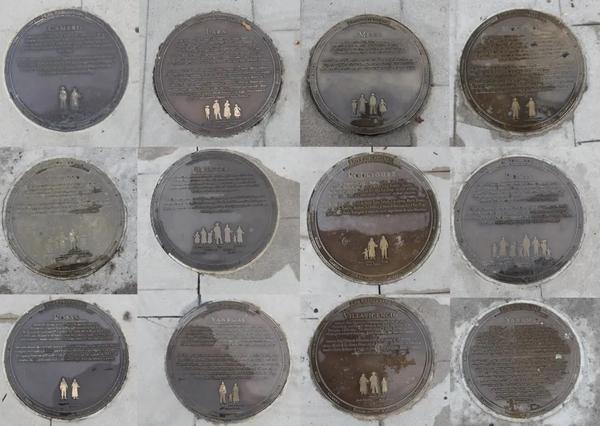
city on top of a thriving indigenous society. In the Los Angeles Plaza today, you can see them remembered with concrete medallions, one of which honors the indigenous town of Yangna that has been on the site.
Markers for the families, 11 men, 11 women, and 22 children who founded Los Angeles and the displaced Tongva town of Yangna on the southern side of the Los Angeles Plaza. Northwest of Pueblo de los Angeles, where Beverly Hills stands today, the Tongva people once lived in numerous villages on a fertile plains watered by streams and waterfalls from nearby canyons. When explorer Gaspar de Portolà laid eyes on the “advantageous” site from the hill where Dodger Stadium sits today, he translated the Tongva name to
Spanish. The Tongva’s paradise became Rancho Rodeo de las Aguas, or Ranch of the Gathering Waters. The land was allotted to a soldier from the expedition or a settler family. When María Rita married Spanish soldier Vicente Fernando Villa in 1808, the ranch became their home. Little information has survived about their family life, thought they raised at least three children. Some sources say seven daughters, other eleven offspring. For sure, it must have been an event in 1821 when Mexico declared independence from Spain. Tragically, Villa died in 1821, leaving his widow in a precarious position. But María Rita managed to hold on to her land and is believed to have built her home at the intersection of present day Alpine Drive and Sunset Boulevard.
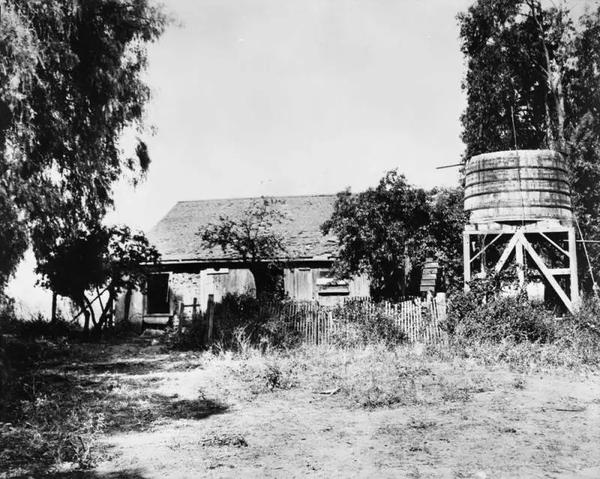
The house of the Rodeo de las Aguas Ranch was located east
of where today is the lavish Beverly Hills hotel. (Los Angeles Security Pacific National/Public Library Collection) Maria Rita applied for title to the land
and after ten years the governor of the Mexican-controlled California territory her the acreage constitute the core of present-day Beverly Hills. At the time, to
keep their land grant owners had make sure the property turned a profit. Maria became a successful entrepreneur, hiring mostly native cowboys to raise cattle and horses. She managed sales and a smaller produce farm. She welcomed travelers and neighboring ranchers in her adobe home, one of the earliest in the region. Her livestock grazed free range and every year the cowboys rounded them at a rodeo located near today's intersection of Pico and Robertson Boulevards.
Today Rodeo Drive honors the ranch which she was in charge of for decades.
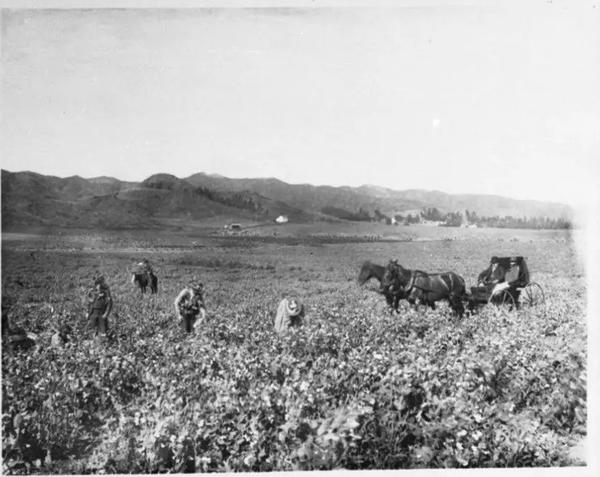
Group of workers, possibly picking lima beans, circa 1903, when the ranch was
owned by Hammel and Denker, photo courtesy California Historical Society. Maria Rita nearly lost her ranch at the outbreak of the Mexican-American War in 1846. "My family and I fled our home... with the political unrest and the arrival of Americans in the city," she said. "And when we returned, we realized that our house had been looted." She was now a resident of the United States, those like her who had been granted land under Spanish or Mexican rule now had to prove their ownership. She testified that during the violence of 1846, she'd lost her documents. She filed a claim for Rancho Rodeo de las Aguas with the Public
Land Commission in 1852 Shortly afterward, she had to take up arms to defend her ranch. As the Indigenous population dwindled due to disease,
deprivation and forced labor, Tongva routinely hit up fertile ranch lands for food and livestock. Maria Rita survived an attack against her ranch in 1852 that ended in a shootout among walnut trees located where Benedict Canyon and Chevy Chase drives intersect today. Two years later, Maria Rita decided to retire from ranching and sold the property. At 63, she moved to a home she'd built in El Pueblo on La Plaza, current day Main Street. Some years after her death the US government acknowledged she owned the property, which she had already sold for about $1 per acre.
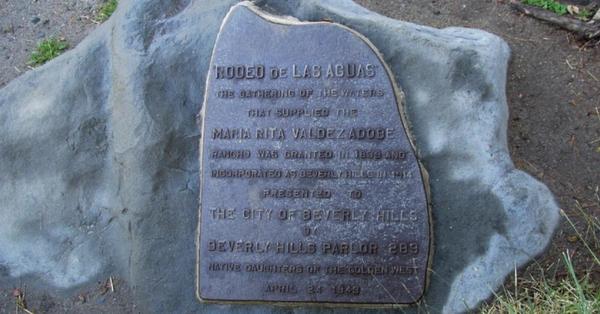
The plaque in commemoration of Maria Rita Valdez in Beverly Hills
"The story of Maria Rita shows the layers of colonialism in Los Angeles. She was the granddaughter of people who are the product of colonialism. Her grandparents are part of that project of colonizing Los Angeles and she takes a plot of land that is in an indigenous sacred space," says David Torres-Rouff, a professor of history at the University of California, Merced. With the American government, came a new attitude toward race in Los Angeles County. For most of Maria Rita's life, she lived in a society not organized around skin-color. Divisions related to socioeconomic status didn't
run along race or mixed-race lines. The new administration also targeted many of the Tongva and other Indigenous peoples in the region. They arrested them on bogus
charges and levied fines they couldn't pay, creating a class of convict laborers. It became a system of legalized slavery to the expand the city of Los Angeles for Anglo-American settlers, who became the new majority in the area by 1880.
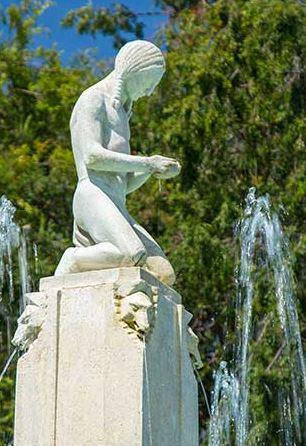
A Tongvan man offers a prayer of thanks for abundant water atop the Electric
Fountain at the intersection of Wilshire and Santa Monica Boulevards. By 1914, Beverly Hills had become a city, but its real boom began when Mary Pickford and Douglas Fairbanks built Pickfair on Summit Drive. They attracted Hollywood stars and launched Beverly Hills as the celebrity neighborhood it is today. So many famed streets like Rodeo Drive and Sunset Boulevard... couldn't one be named María Rita Avenue?
Like my article today? Forward this email to share with family and friends.
Follow me on social media
This newsletter is a reader-supported publication. To support my work, consider becoming a paid subscriber.
Read
a great book? Have a burning question? Let me know. If you know someone who might enjoy my newsletter or books, please forward this e-mail. I will never spam you or sell your email address, you can unsubscribe anytime at the link below. To find out more about my books, how I help students, teachers, librarians and writers visit my website at www.MaryCronkFarrell.com. Contact me at [email protected]. Click here to subscribe to this newsletter. |
|
|