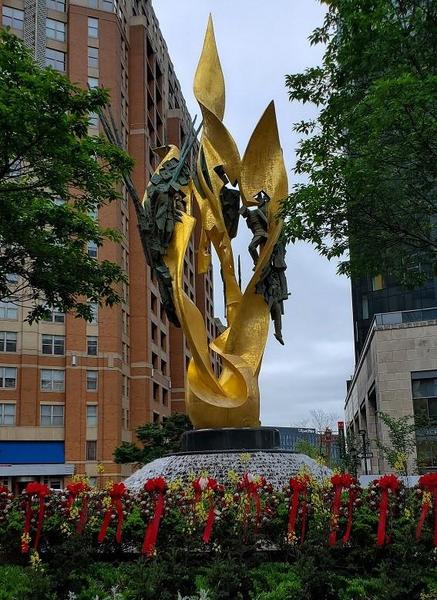
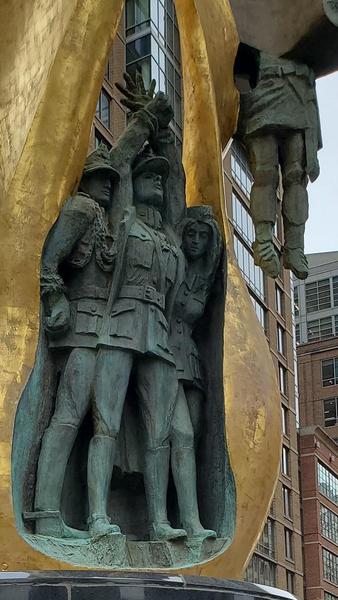
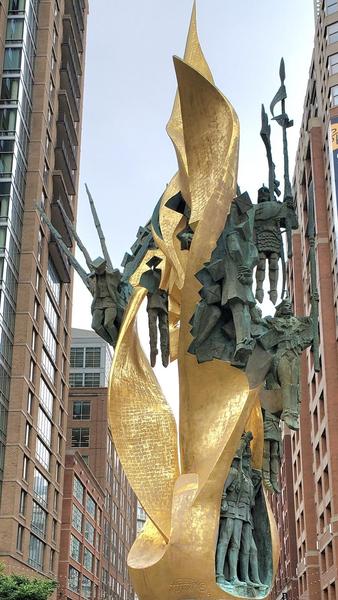
May 1, 2026 Hello , I'm in Baltimore, Maryland, today. Mike had a conference, so I came along to see the sights and dig up some history. This eye-catching monument stands a few steps from the door of our hotel in the Inner Harbor and it sparked my first history lesson.
Katyń Memorial, Baltimore, MD, photo by the author. In part, the memorial
honors a polish woman and WWII air force pilot, who was the first woman in Europe to parachute from a plane over three miles high. There is much more to the story, (below) but for Americans, Baltimore is maybe most famous for Fort McHenry, the scene of a British assault during the War of 1812. That's when Frances Scott Key spied the American flag still flying over the battered fort at dawn and wrote the poem that became the national anthem, The Star-Spangled Banner. We walked around the harbor to see what we could see at Fort McHenry.
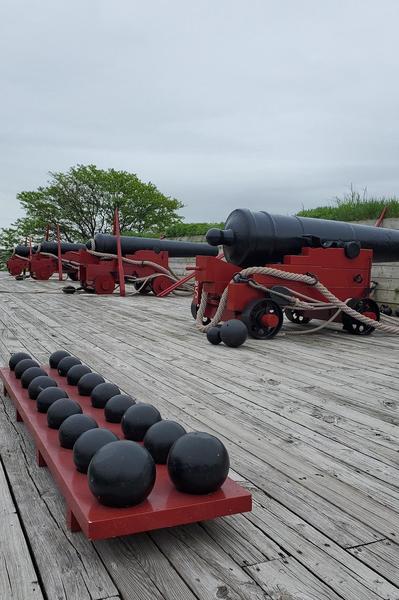
Guns at Fort McHenry, Baltimore, MD, photo by the author.
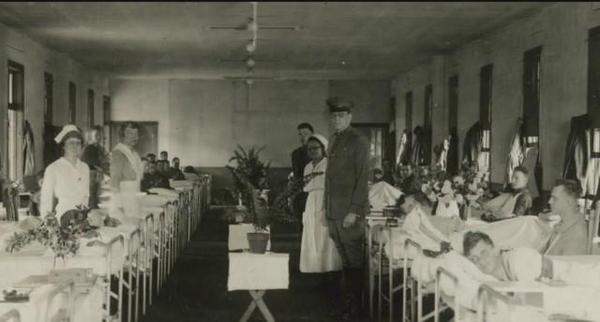
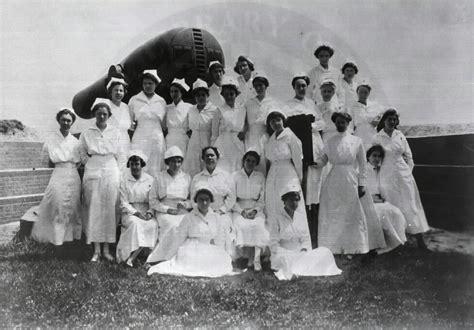
Strolling over the wide, green expanses of grass on the grounds of Ft. McHenry, we learned that in WWI the US Army hastily constructed a military hospital on the grounds to receive wounded soldiers from the war fields of France. More than 100 buildings covered nearly ever square foot of the 40 acres of ground. Hospital No 2 admitted up to three-thousand soldiers at a time, treated by more than one-thousand doctors, nurses and staff.
Doctors and nurses tend to sick and injured WWI "doughboys"
at U.S. Army General Hospital No. 2 at Ft. McHenry in Baltimore, Maryland. US Army photo. US Army Nurse Emily Raine Williams said, "our work here was no less heroic than the ones who went over [to France]..."
The surgical teams at the hospital from 1917-1923 made
remarkable advances in neuro and reconstructive surgery, treating soldiers with grave injuries to their faces. The never before seen cosmetic surgery results seemed miraculous. The Ft. McHenry facility became one of the first US military hospitals to focus on training and education to reintegrate soldiers into civilian life. All the while I toured Ft. McHenry, part of my mind remained on the striking monument built to honor Polish military officers massacred by the Russian secret service in 1940, in particular the one woman murdered along with 20,000 of her brethren. You didn't misread that, 21,857 Polish POWs executed in cold blood and buried in mass
graves in Russia's Katyń forest. In the photo below, you'll see a representation of Lieutenant Jawidga Lewandowska, third figure to the right. In the research, she's
identified as Janina Antonina Lewandowska.
The inscription reads, "When duty called they answered. When they refused the embrace of Stalin- they died. Now we commend them to the ages to be included amongst history's
martyrs. The executions started on April 3, 1940, and continued daily through the first week of May. It was called "one of the most barbaric international crimes in the history of the world," after an investigation by the US Congress in 1952. But the truth more than a decade after the killings, the truth was covered up and lied about for 70-years, the last evidentiary documents remaining classified until 2010. When relating history, it's always difficult to choose a starting point. For this story, let's
take the The Molotov–Ribbentrop Pact, officially the Treaty of Non-Aggression between Germany and the Union of Soviet Socialist Republics. Signed in August 1939, it divided Eastern Europe between the two powers and a month later they both invaded Poland, Germany from the west and Russia from the East. Polish forces were quickly overwhelmed, and tens
of thousands of POWs taken. Within months, Russia seized leaders in Poland who would resist its takeover of the governing structure. The executions included civilians such as: three landowners, 20 university professors, 300 physicians, several hundred lawyers, engineers, several hundred teachers of secondary and elementary schools and more than 100
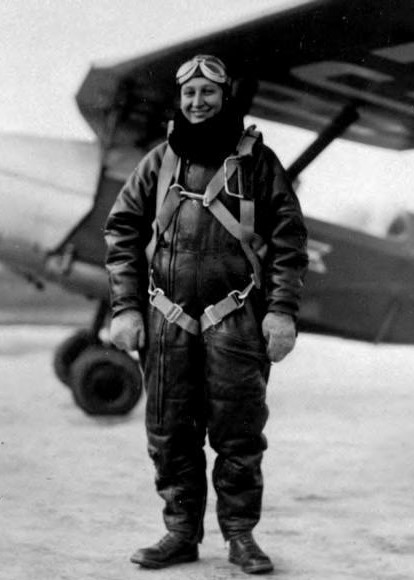
writers and journalists. The majority of those murdered and buried in the Katyn forest near Smolensk Russia were military officers, including two generals, 24 colonels, 79 lieutenant colonels, 258 majors, 654 captains, 17 naval captains, and 200 pilots, one of which was 2nd Lieutenant Jawidga Lewandowska
Jawidga Lewandowska standing in front of a RWD 8 trainer aircraft, public domain. Jawidga grew up Poznań, Poland, the dauther of a Polish general who taught her and her three sibling horseback riding, skiing, and swimming. As a teenager she took to the air at the Poznań Flying Club and earned her glider and parachutist certificates. But what Jawidga really wanted was to be singer and after high school
attended the Music Academy in Poznań. She kept on with her flying and at age 20 became the first European woman to jump from a plane flying more than three miles high. Her father didn't approve of her singing career and so she took a job as an assistant at the post office and continued to advance her knowledge and skill piloting light
aircraft. With war on the horizen, in August 1939, Jawidga married instructor-pilot Mieczyslaw Lewandowski and got drafted into the Polish Air Force. Shortly after the Soviet invasion of Poland, Lewandowska's unit crossed into Hungary where on September 22, they were
taken POW by Russian forces. She and the one other officer in the unit the POW Camp for Polish Officers in Ostashkov, Russia, and later to the camp in Kozelsk. Over the following months, the Russians filled three POW camps on the grounds of monasteries in western Russia Kozelsk, Starobelsk and
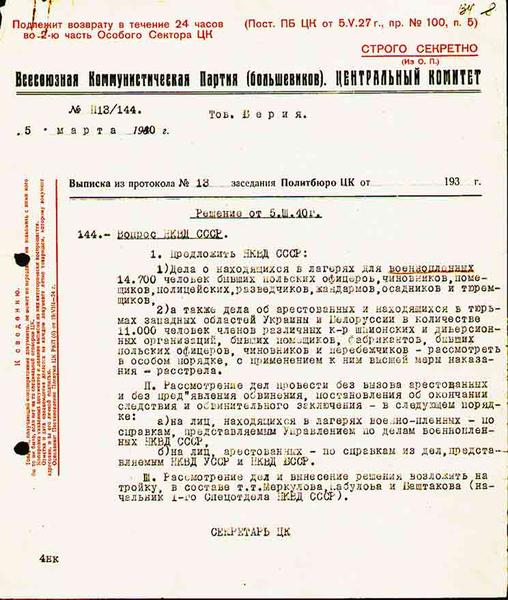
Ostashkov. They were run by the Soviet Secret Police known as the NKVD. The NKVD interrogated each prisoner, taking down their identification and judging whether they could be turned to the Soviet cause. In early March 1940, they decided to murder every person in the camps. The document below would become important evidence over the decades as German troops uncovered the bodies in mass graves in April 1943, and Russia shifted blame for the killings to the Nazis. Numerous investigations pinned the crimes on one or the other until the 1980s. This is the
execution order signed by Josef Stalin.
"Top Secret" decision of the Central Committee's Politburo dated 5 March 1940. (from the archives of the Katyn Museum in Warsaw) Second Lieutenant Lewandowska, pilot, parachutist and signer, was most likely shot on April 22, 1940, her 32nd birthday. She was the only servicewoman murdered in what has become known as the Katyń Massacre. One year later, her remains were uncovered by the Nazis who internationally publicized the mass graves. Many prisoners were shot to fall into pre-dug graves. Others were executed one at a time in sandbagged bunkers. In the beginning, Russian pistols were used, but they had a strong recoil and men were too bruised to continue after
shooting a dozen people, so they switched to German pistols. One Russian officers bragged he had killed over 7000 men by May when the camps were emptied.
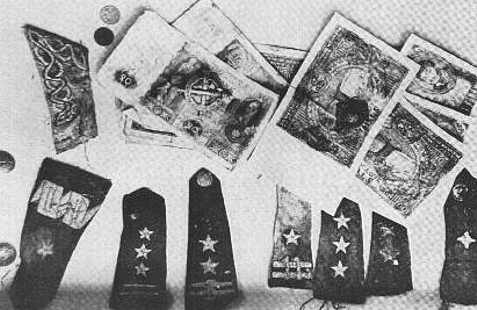
Polish banknotes and epaulets recovered from mass graves of polish officers killed by NKVD in Katyń
Forest in 1940, public domain.
A
year a later, the German army overtook the area in April 1941, and discovered one of the burial sites. The Nazis seized on the atrocity, internationally publicizing the Soviet killings. Later that year, the Russians pushed the Germans out of Kaytn and started a coverup operation planting false evidence to incriminate the Germans.
Rows of exhumed bodies of Polish officers placed on the ground by the mass graves, awaiting examination. Public domain.
One after another investigations indicated Soviet War Crimes in Katyń forest, world leaders found it politically expedient to let the blame lie with the Nazis. Despite overwhelming evidence, the United States and Great Britain essentially remained
quiet on the subject until the Soviet Union admitted in 1989 Stalin had ordered murders. In 1990 Mikhail Gorbachev admitted the NKVD had executed the Polish Nationals and confirmed two other burial sites similar to the site at Katyń. In Poland some people believe all the graves will probably never be found. Monuments to honor those slain now stand on the site as well as in places
around the world. The American Polish community dedicated the one in Baltimore in 2000, "as a permanent tribute to all mistreated prisoners of war with the Katyń forest massacre serving as an extreme example. All are remembered here in prayer and reflection."
Katyń Memorial, Baltimore, MD, photo by
author. The artistic fire represents rebirth or transformation and envelops the Katyń martyrs in its flames, raising them spiritually into the pantheon of national heroes of Poland.
Like my article today? Forward this email to share with family and
friends.
Sources https://eng.ipn.gov.pl/en/news/4029,Janina-Lewandowska-the-only-servicewoman-murdered-in-Katyn.html
Follow me on social media
This newsletter is a reader-supported publication. To support my work, consider becoming a paid subscriber.
Read
a great book? Have a burning question? Let me know. If you know someone who might enjoy my newsletter or books, please forward this e-mail. I will never spam you or sell your email address, you can unsubscribe anytime at the link below. To find out more about my books, how I help students, teachers, librarians and writers visit my website at www.MaryCronkFarrell.com. Contact me at [email protected]. Click here to subscribe to this newsletter. |
|
|