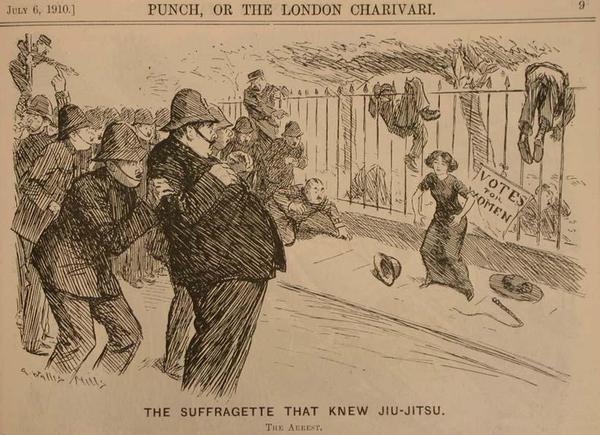
May 8, 2026 Hello , Suffrajitsu. I'm not making that word up! That honor goes to an anonymous journalist covering the violence of the British suffragette movement in the spring of 1914. The art itself, jujitsu training for women fighting police in the streets of London and Glasgow for the right to vote, came from Edith Garrud. Less than five feet tall, she took an immediate fascination with the Japanese martial art, learning it and teaching it to women and girls. She tells the story of facing off with a police constable while protesting for women's suffrage outside the British Parliament. He told her to move along and not create an obstruction. "Excuse me, it is you who are making an
obstruction," she said and threw him over her shoulder.
Edith Garrud's husband taught sports, concentrating on gymnastics, boxing and wrestling. In 1899, at the age of 27, Edith accompanied him to a martial arts exhibition. She
called it the underdog’s martial arts form because jujitsu uses opponents' own weight and momentum against them while targeting pressure points. “Jiu-jistu literally means ‘the soft art’,” Edith said, “it’s the balance of art and
leverage, as easy as A, B, C, and as easily learnt as a child learns to walk.”
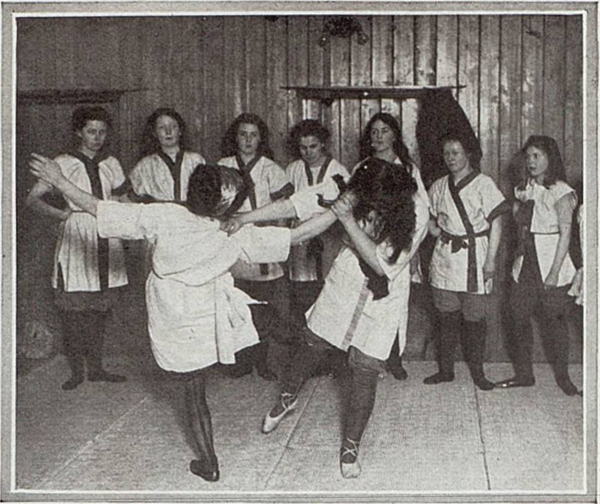
A rare glimpse of one of Edith Garrud’s jiujitsu classes for girls at the her dojo. The unusual gi
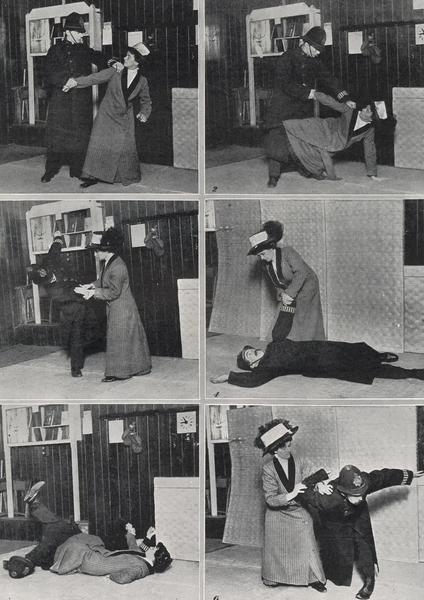
jacket designs, featuring dark ribbons along the hem-lines, may have been unique to these classes. Originally published in The Sphere of Feb. 11, 1911. Edith became one of the first women to teach jujitsu in the West. She promoted it to women by writing articles and giving demonstrations. She played the lead in an early action film and choreographed a fight scene in a play on the London stage. She cut an striking figure, dressed in Edwardian ladies clothes defending her 4' 11" inches against officers of the Metropolitan Police, who at the time had to be no less than 5' 10".
Edith Garrud demonstrating jujitsu techniques on a volunteer dressed as a police
constable. Meanwhile, got involved in the Women's Rights Movement, agitating for the vote. She and her husband were invited to give a jujitsu
demonstrations in 1908 at a meeting of the radical Women's Social and Political Union (WSPU). William Garrud, who normally did the talking while Edith showed the
moves, was sick so Edith went by herself. Leader of the WSPU Emmeline Pankhurst convinced her do the speaking and soon she was teaching the suffragettes jujitsu to counter the violence that met their protests. That gave some people a laugh or two, but the Votes for Women struggle had become increasingly bitter and violent.
The
Suffragettes made some progress with the British Liberal Party and in November 1910, Parliament considered legislation that would give the vote to about a million women, mostly wealthy property-owners. The WSPU’s leaders supported the bill, and paused their militant campaigning. The House of Commons had passed sweeping reforms to address poverty and workers’ rights, but the House of Lords rejected them. Seeking support for both the budget and reduction of the Lords’ power, Prime Minister Asquith call a general election and that ended consideration of the votes from women legislation. Roughly 300 women had gathered for a peaceful march, but now they felt betrayed by the prime minister and arrived at Parliament Square demanding to see him. Suffragette Annie Kenney described the scene like a storm-burst "There was a great storm-burst. All the clouds that had been gathering for weeks suddenly broke, and the downpour was terrific... There was not one
of us who would not have gone to our death at that moment, had [our leader] so willed it." Bystanders first began shout at the women and grope them.
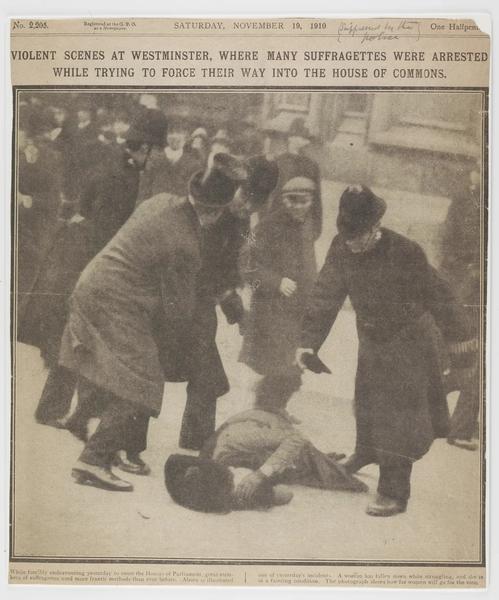
As they attempted to enter Parliament, a solid formation of policemen heavily outnumbered the women. The male vigilantes and constables continued their assault—verbal, sexual, violent—for six hours as members of the WSPU tried to enter the House of Commons after the prime minister refused to see them and the suffragettes refused to give up.
Suffragette Ada Wright is viciously beaten by police officers
on Black Friday. Westminster, England. 1910. Wikimedia Commons "Several times constables and plain-clothes men who were in the crowds passed their arms round me from the back and clutched hold of my breasts in as public a manner as possible, and men in the crowd followed their example,” described one
Suffragette. “My skirt was lifted up as high as possible… [the constable] threw me into the crowd and incited
the men to treat me as they wished." Injuries ranged from black eyes, bruised bodies and nose bleeds to more serious injuries that required treatment
at a medical post set up at Caxton Hall. In the end police arrested 115 women and four men. The day is remembered as Black Friday and became a turning point for
Britain's women's suffrage movement. The group started using guerrilla tactics like arson and vandalism to fight for their right to vote. WSPU leaders determined
they should always be prepared to defend themselves at future demonstrations. A group of about thirty women formed a unit called the Bodyguard and Edith Garrud started the twice-weekly Suffragettes' Self-Defence Club at her dojo, exclusively for WSPU. The group met in secret between demonstrations for training, and planning protection for their leaders and sabotage. They could a sudden phone call with instructions for duty, such as to follow a certain car. It was dangerous, but they were fighting for their rights and Edith gave them the skill and empowerment to defend themselves against violence and intimidation. Still the Bodyguard were often outnumbered by police and if violence erupted, women were injured and arrested. In prison, their only weapon was the hunger strike. Jujitsu was no use
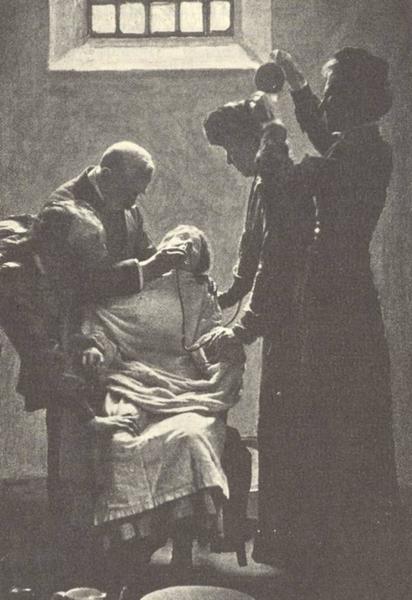
against force-feeding a painful procedure that often involved shoving rubber tubes up their noses.
Guards force-feed a suffragette on hunger strike in HM Prison Holloway. London. 1911. Wikimedia Commons In response to the public outcry against force-feeding, in 1913 the government passed a law that came to be called The Cat and Mouse Act. It allowed for the early release of prisoners so weakened by hunger striking they were at risk of dying. Once their health recovered the women would be sent back to prison. The Bodyguard would be called into action to keep leaders of the movement from being recaptured. For instance, in early 1914, they traveled from London to Glasgow on the overnight train to run interference for the charismatic Emmeline Pankhurst. A crowd filled St. Andrew's Hall in Glasgow, waiting for Emmaline to speak. Police surrounded the building waiting to arrest her when she arrived but Emmaline bought a ticket and entered
the hall as a spectator. The Bodyguard took up their places in a semi-circle of chairs behind the podium. Emmaline stunned the police when she suddenly appeared on stage and
started to speak. She got in about thirty seconds before they recovered and rushed the podium. Bodyguard whipped out bouquets of flowers loaded with barbed wire. Officers swung their bats and the fight was on. Thirty suffragettes and fifty cops brawling before a crowd 4000 strong. The women put up a fierce resistance, but later in the day Emmaline was arrested. The event is now remembered as the Battle of Glasgow. Soon after, a larger battle engaged the whole of Britain. Suffragettes put
aside their fight at the start of WWI to join the war effort.
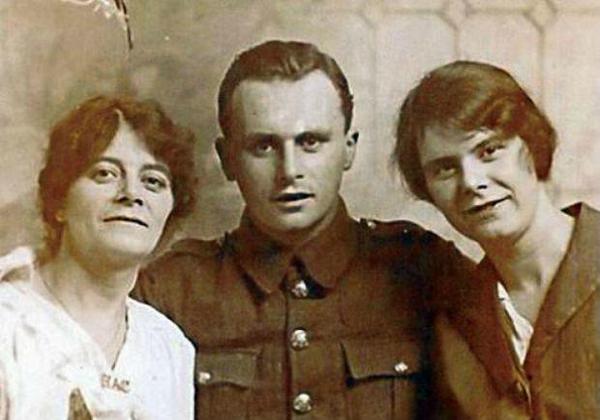
Edith Garrud (Left) with two of her children. Source: Islington Tribune. Women over 30 finally won the right to vote in the UK with the 1918 Representation
of the People Act. Ten years later in 1928, the voting age for women was lowered to 21 and equal to the age for men. Edith and William Garrud continued to work as
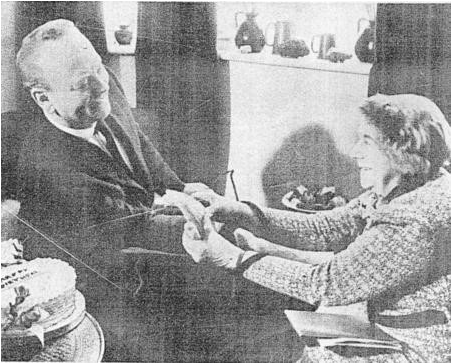
self-defense and jujutsu instructors until 1925, when they sold their dojo. On her 94th birthday, June 19, 1965, Edith was interviewed by journalist Godfrey Winn.
Edith Garrud demonstrates a jujitsu wrist-lock on journalist Godfrey Winn on her 94th birthday. Public Domain. The article appeared in Woman Magazine with the title: "Dear Mrs. Garrud - I wish I'd known you then…" Edith made it clear she didn't want women to commit violence, but rather have the ability to defend themselves, particularly against domestic violence, the most common form of
oppression of women at the time. She urged all women to learn jujutsu, in the hope of dismantling the patriarch one household at a time. Sh lived to be 99-years-old.
Like my article today? Forward this email to share with family and friends.
Sources https://en.wikipedia.org/wiki/Edith_Garrud
This newsletter is a reader-supported publication. To support my work, consider becoming a paid subscriber.
Read
a great book? Have a burning question? Let me know. If you know someone who might enjoy my newsletter or books, please forward this e-mail. I will never spam you or sell your email address, you can unsubscribe anytime at the link below. To find out more about my books, how I help students, teachers, librarians and writers visit my website at www.MaryCronkFarrell.com. Contact me at [email protected]. Click here to subscribe to this newsletter. |
|
|