May 15, 2026 Hello , Mary Fontana was totally engrossed in a book when I met her. A fourth grader, she quietly read while her two brothers and two sisters created a hubbub of activity all around her. I'm not surprised to be telling you Mary's now written her own book. It is incredibly timely,
speaking to us about one of America's most critical issues today. "At Annunciation House, part of my work was was to help guests find a fresh change of clothing," Mary says. "I led
people to the basement clothing bank for “new” shirts, pants, underwear and socks, and shoes.... "Elvis, who was fifteen years old when he journeyed north alone from his home country of Honduras, was thrilled to exchange his
beat-up shoes for a pair of sneakers. “It was nice not to have spines in my feet,” he told Mary.
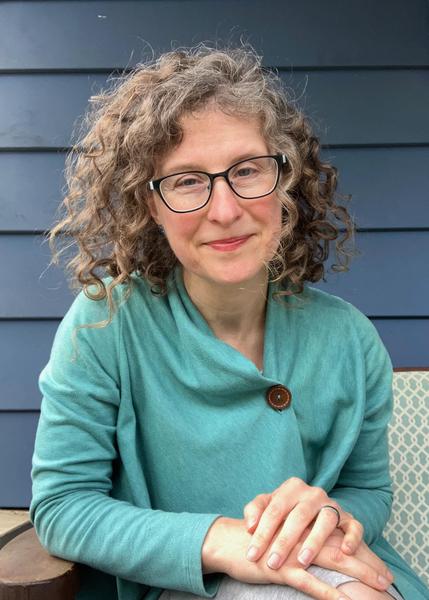
Author Mary Fontana has supported migrant hospitality efforts in El Paso for over two
decades. She lives in Seattle with her husband and two boys. When migrants’ feet were blistered by miles of walking or lacerated by cactus spines," Mary says. "I washed and bandaged them then combed through the clothing bank for a forgiving pair of Crocs or Birkenstocks
that could easily slip over bandages. It was also Mary's job to sort through bags and boxes of donations to restock the clothing bank. T-shirts and jeans overflowed, but sturdy shoes were like precious gems—rare and scarce," Mary says. "I sifted through bags and boxes
looking for matched shoes in good condition. You’d be surprised how many single shoes end up in donation bins." The State of Texas is currently trying to
shut down Annunciation House and it's service to migrants. Mary Fontana writes my feature story this week about the woman who started it 50-years ago.
“Estás en tu casa,” Make yourself at home
Delia Gomez descended from Mexican ancestors who had lived in the Rio Grande river valley for generations. Her family never emigrated north
across the border; rather, the border crossed them. In 1848, when Mexico ceded over half its northern territory to the United States after the Mexican-American War, the Gomez family’s long-established community became a part of Texas.
Yet despite her deep roots in the region, Delia was often treated like a foreigner in her home city of El Paso. Like most of her classmates in elementary school, she had brown skin and hair and spoke Spanish at home. But her teachers
were almost exclusively white. They punished kids for speaking Spanish and made the Mexican-American children sit toward the back of the classroom, sorting the small number of white kids up front. Delia was a straight-A student, bilingual, bright and attentive. But when the teacher asked a question, she waved her hand eagerly from the
back of the room only to be ignored. For years, she felt subconsciously that the white students must be smarter than her, because they got called on and she did not.
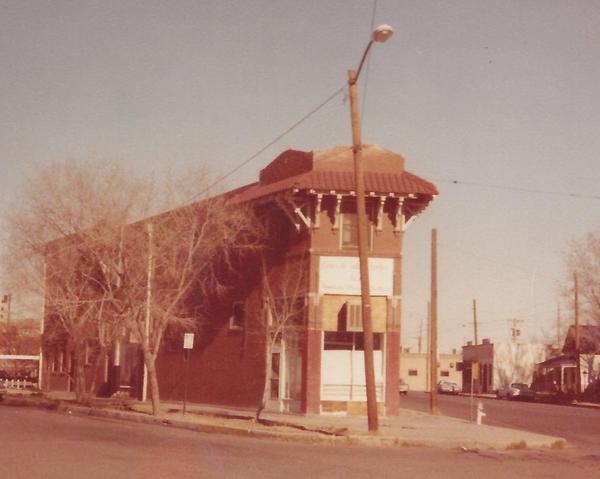
Annunciation House in 1978. The building is located in El Paso's Segundo Barrio, an economically poor but culturally rich neighborhood directly adjacent to the US-Mexico border. It was only later that Delia recognized the insidious workings of systemic racism that, she felt, had tried to set her up for failure. As a young woman at the University of Texas at El Paso she got involved with MEChA, the Chicano student organization, whose members celebrated their Mexican-American identity and organized for political power. She reflected on the bitter experience of being treated like an outsider because of the color of her skin and the language of her ancestors.
And she developed a burning desire to work for justice in the city she called home.
In her mid-twenties, Delia was attending college part-time while teaching adult education classes at a men’s prison. But she felt something was missing. She craved greater meaning and purpose
in her life, and thought she might find it through some kind of intentional community.
This was the 1970’s, when various
experiments in communal living—from hippie communes to Catholic Worker Houses—were playing out all across the country. A devout Catholic herself, Delia began to explore the idea of starting a community house centered on voluntary service. Through her involvement with the Catholic Church, she met other young adults who shared her desire to live with greater purpose. One of them was Ruben Garcia, then the director of El Paso’s Catholic youth department.
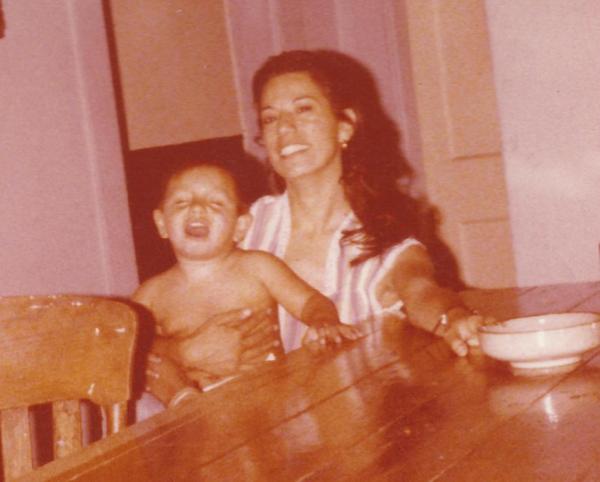
Delia Gomez in 1978 with a young Annunciation House guest named Oscar. In 1978, Delia and Ruben moved into a rundown building in central El Paso, close to the US-Mexico border, with three other Catholic young adults. The five had agreed to form an intentional community devoted to service. They called their new home Annunciation House.
Initially, the five young founders didn’t have a clue what form their community service would take. This lack of a defined mission
was intentional: they wanted to serve people in their community who had “fallen through the cracks,” as they put it, and they needed time to understand who those people were. They wanted to let a mission find them. So they worked and prayed and listened and got to know their neighbors.
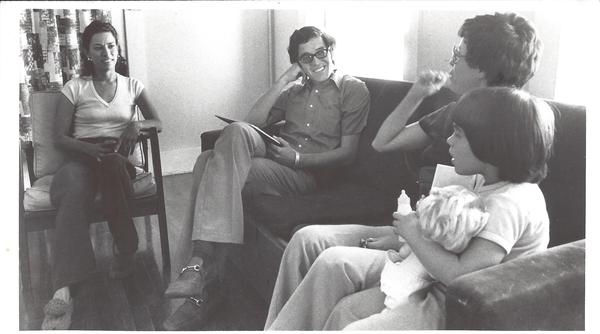
Delia (left) and Ruben Garcia (second from left) talking to some
visitors in the living room of Annunciation House in 1979. Gradually, they realized that the people in El Paso with the greatest need, the least access to resources, were the undocumented. People without US papers were were turned away from existing homeless shelters and food banks. And the number of undocumented people in El Paso was rising just then, as wars and
political violence in several Central American countries sent refugees fleeing northward. Thus, over the course of several years, Annunciation House found its focus: it would be a house of hospitality for the undocumented poor in migration.
By the time this mission crystallized, three founders had decided to move on. Delia and Ruben remained. Soon the house was receiving
hundreds of people each year, most of whom had fled violence in Nicaragua, El Salvador and Guatemala.
They came by word of mouth or were brought to the house by sympathetic church members. Some stayed for a few days, others for a year. Delia and Ruben set up dormitories lined with bunk beds and a dining room with a long table. They lived and
worked in the house alongside their guests, who shared in meals and chores. Each new person was greeted with the welcoming words, “Estás en tu casa,” “Make yourself at home.”
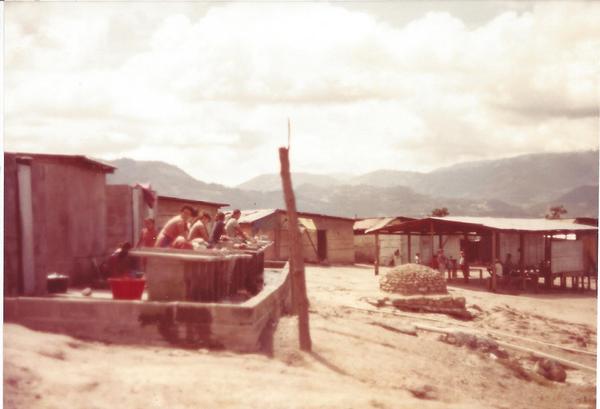
The Mesa Grande refugee camp in Honduras, operated by the UN High Commissioner
for Refugees. Ruben and Delia visited in 1984 and smuggled out children's drawings depicting a massacre at the Río Lempa on the border between El Salvador and Honduras. As they got to know their guests, Ruben and Delia heard stories of terror and violence that appalled them: a family member murdered by a death squad in El Salvador, an entire village in the Guatemalan highlands burned. “A soldier can kill you just because he doesn’t like you,” said one Salvadoran teenager, “and no one will care.”[1]
Ruben and Delia felt an increasing need to see these horrifying conditions for themselves. In 1984, they drove from El Paso through Mexico to Central America. Stopping in five countries, they met secretly with activists, visited refugee camps, and witnessed the first presidential election
following Nicaragua’s revolution.
They returned to the US with reams of documents detailing government atrocities and
missing family members. The documents included a handful of chilling crayon drawings of a massacre, made by Salvadoran children in a Honduran refugee camp and smuggled out from the camp in Ruben’s knee-high socks.
Even before visiting Central America, Delia and Ruben
had helped a few guests apply for political asylum in the US. But now they were more convinced than ever that the refugees arriving at their doorstep needed protection.
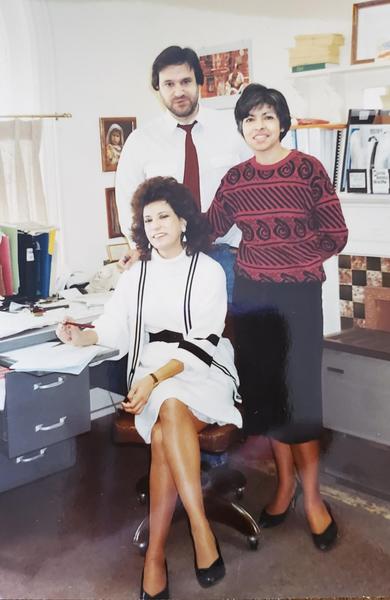
In 1987, the pair founded a second nonprofit organization that would focus exclusively on legal services: the Las Americas Refugee Asylum Project. Delia became its first executive director. Las Americas helped Annunciation House apply for political asylum, even though they stood little chance of getting it.
Delia (seated) with the founding staff of the Las Americas Refugee Asylum
Project in 1987, in the organization's original one-room office. During the Cold-War 1980’s, refugees from Communist countries like China and Cuba readily won asylum, whereas over 97.5 percent of applicants from El Salvador and Guatemala, countries led by US-backed right-wing dictatorships, were denied. [2]
Delia steered Las Americas by the same star that had guided her work at Annunciation House: the people who came to their doors would show them what they needed to do. There was little grant money available to support legal resources for the politically charged work of asylum. Nevertheless, Delia was determined not to allow the need for funding to change the organization’s mission. “I made a conscious decision all those years to stay focused on political asylum, because it was still a need,” she said later.
“Until that day came when we’d say, ‘Political asylum is not a need,’ we’d do it.”[3]
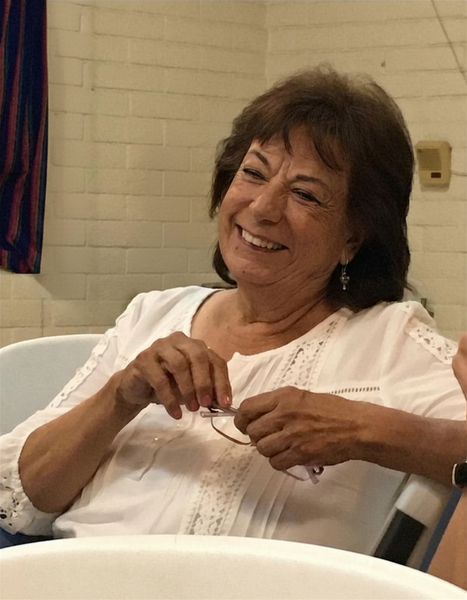
Delia is now in her mid-seventies. She has retired, but the two organizations she helped found are thriving.
Delia Gomez, a founder of Annunciation House and Las Americas in El Paso, TX.
Nearing its fiftieth anniversary, Annunciation House has grown into a network of hospitality houses and received
over half a million refugees from around the world. Ruben Garcia still leads the organization, supported by a group of dedicated volunteers.
Meanwhile, Las Americas has provided legal services to over fifty thousand people from around eighty different countries. Over time its
portfolio has broadened to assist detained minors and immigrant woman victims of violence, but it has never abandoned its foundational commitment to asylum seekers. It remains one of the few legal clinics available at low or no cost to immigrants and refugees in West Texas.
Delia serves on Annunciation House’s board of directors and continues to be an avid supporter of both organizations. Her determination and commitment have inspired many people—including this writer, a former Annunciation House volunteer. “Injustice angers me,” she once told a reporter, “but in a way, that’s a healthy anger. You can deal with it
destructively or constructively. I chose constructive.”[4]
I’ve gotten to know Delia by serving with her on the Annunciation House board, which I joined about fourteen years ago. She’s a humble, good-humored person who has always been frank about her own doubts and difficulties. Years ago, when I was wrestling with big decisions in my own life, I asked her if she’d ever questioned whether she was in the right place at Annunciation House. “I questioned it all the time!” she replied. “What are we doing? Will I be able to do this? Do I want to give everything away?.… And will it work? Will I be able to live with these people? All these difficult questions.” Delia shared with me something she’d written in her journal in the very early days of her service work:
“I want a normal life, but I want this life too.”
Many thanks, Mary, for writing my feature story this week! Wishing you all the best with your new book! ⬇️⬇️ Keep reading below for more news about Mary and her book, and about the Texas Attorney General's attack on Ascension House and other Texas non-profits serving the basic needs of migrants. ⬇️⬇️
Like Mary
Fontana's article today? Forward this email to share with family and friends.
Sources [1] Annunciation House newsletter, 1983. [2] “Procedures for Gaining Asylum
Draw Sharp Criticism,” El Paso Herald-Post, March 18, 1986. [3] Author’s interview. [4] Laurie Gallardo, “Faith Drives Woman to
Help Others,” El Paso Herald-Post, March 14, 1997.
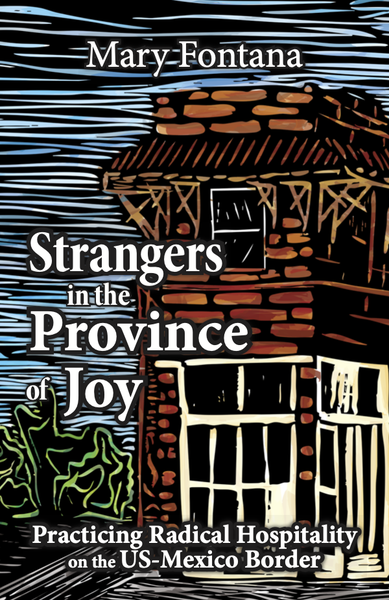
Here's what Beto O'Rourke says about Mary's book: “An incredibly uplifting story of how one community’s relentless hospitality and grace reveal the way to repair the deep damage we have done to the people of the Americas, to the border and to our spirit. These are the kind of heroes we need in America today. A must-read.” —Beto O’Rourke, former congressman and author, We’ve Got to Try.
From the publisher: This is the story of America writ small—a nation founded by immigrants and its shifting,
oft-contradictory attitudes toward them. Since 1978, El Paso’s Annunciation House has welcomed over half a million people: migrants and refugees, doing what humans have always done to find sustenance and safety, and volunteers seeking meaning and purpose. Through this chronicle of their individual journeys, Mary Fontana exposes the forces driving global migration and challenges readers to confront the borders in their own hearts.
On Feb. 7, 2024, representatives from Texas Attorney General Ken Paxton's office arrived at Annunciation House demanding to enter the shelter and examine its business records. Annunciation leaders refused to turn over documents and Paxton filed for a court
injunction to close the shelter. In court documents and public statements, Paxton accuses Annunciation House of "harboring illegal aliens" and serving as a "stash house" engaged in human smuggling. An initial district court ruling blocked Paxton from getting the documents and shutting down the House. The attorney general threatens to close down at least four other non-profits in Texas that serve the basic needs of migrants.
This newsletter is a reader-supported publication. To support my work, consider becoming a paid subscriber.
Read
a great book? Have a burning question? Let me know. If you know someone who might enjoy my newsletter or books, please forward this e-mail. I will never spam you or sell your email address, you can unsubscribe anytime at the link below. To find out more about my books, how I help students, teachers, librarians and writers visit my website at www.MaryCronkFarrell.com. Contact me at [email protected]. Click here to subscribe to this newsletter. |
|
|