May 22, 2026 Hello , It's been a tough week and I ran out of time. But here's a re-run of a story I wrote you in 2019 about Susan La Flesche of the Omaha Tribe who embraced the best of Native and White cultures to save her people and their culture. In native tribal language, Omaha means "against the
current." Susan La Flesche was certainly paddling her canoe upstream in the late 19th Century when she became the first Native American to train and practice as a doctor of western medicine. The young Nebraska woman faced the formidable challenges of negative attitudes about Indians, but also limiting views about women's roles.
Embracing Two Cultures to Save her People
When Susan La Flesche applied to medical school in 1886, the United States did not recognize Indigenous people like the Omahas as American citizens. And though women were often healers in the Omaha Tribe, many Americans had the notion that the stress of
attending college would injure women's reproductive organs. Susan was accepted by Woman's Medical College of Pennsylvania, one of the few schools on the east coast that allowed women to study medicine. Of both Indigenous and European blood, Susan assimilated into the white world to become a doctor and then returned to the Omaha reservation where she
served more than a thousand patients scattered over 1,300 square miles.
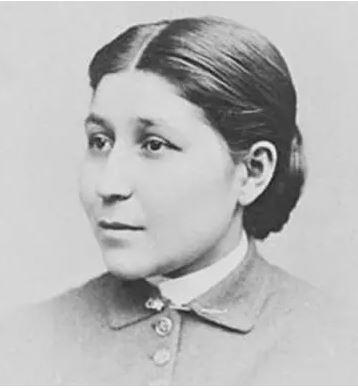
Susan La Fleshe, National Anthropological Archives, Smithsonian Institution, Public Domain. First, a little context to set the stage for this determined and courageous woman.
The Omaha Tribe thrived, farming and hunting in the eastern woodlands of Ohio until whites arrived and forced native peoples to retreat west. By the 1700s the tribe had adapted to survive on the plains of what is now Iowa and Nebraska.
Under the leadership of Chief Blackbird, the Omaha became politically and militarily strong by taking control of the fur trade on the upper Missouri River. Then a small pox epidemic struck in the early 1800s, killing Chief Blackbird and a full ninety percent of the Omaha people.
Shortly, the tribe found itself pinched between a surge of white settlers rushing west, claiming homesteads and native plains warriors pushing back.
They had little option but to accept one treaty after another gobbling up their hunting grounds and destroying their ability to survive on their
own. Five deals with the federal government between 1815 and 1865 left them with a small reservation on the banks of the Missouri River, where Susan La Flesche was born in a buffalo skin tipi. That summer the tribe's men left for their final
buffalo hunt. In the following years as Susan grew into a toddler and a young girl, the Omaha people faced a dilemma. Without the life-sustaining buffalo, they would assimilate or die. At the age of eight, Susan made a decision. She had sat up all night with a sick woman. The doctor was called from the
nearby mission, but he did not come. Through the night as the woman's condition worsened, he was summoned another three times. The woman died the next morning, and the doctor still had not shown up. To Susan it was clear. “It was only an Indian and it did not matter.” She determined then that she would do
whatever she could to help her people survive.
At age ten, she went to a Presbyterian mission school. She knew the Omaha's traditional songs, beliefs, customs and language, now she learned English and became a
Christian. At 14, she went east to attend a girls’ school in Elizabeth, New Jersey, followed by studies at Virginia’s Hampton Institute, a school founded to "civilize and educate" Native Americans and children of former slaves. The long years she spent away from
her homeland on the Nebraska prairie were difficult. One class especially took her mind off being homesick. The human skeleton and anatomy absorbed her interest. Susan decided she would be a doctor, though most medical schools barred women. One of her only options was the Women's Medical College of Pennsylvania in Philadelphia. She applied, was accepted and funds
were raised for her to attend. She graduated with a medical degree in 1889, one year early and first in her class of thirty-six women.
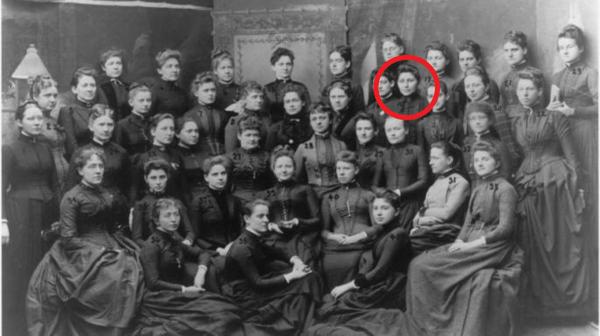
Female physicians, late 19th century. Susan LaFlesche is in the second row from the
back, fourth woman from the right. Legacy Center / Drexel University College of Medicine After graduation, Susan turned down job offers in the east because her plan had always been to return home and provide medical care to the Omahas. But she'd been gone twenty years and thoroughly adopted white ways. In the beginning few on the Omaha
reservation trusted her. Then, apparently, all it took to turn people in her favor, was a good outcome with one patient. As the story goes, an 8-year-old boy she treated for some childhood ailment recovered within 24-hours. Soon, she was making house calls from early morning into the dark of night. If a patient lived less than a mile away, Susan walked for the
visit. She made further trips on horseback, and finally got a buggy, pulled by two horses for the long trips. In winter, she often made those in subzero temperatures and two feet of snow.
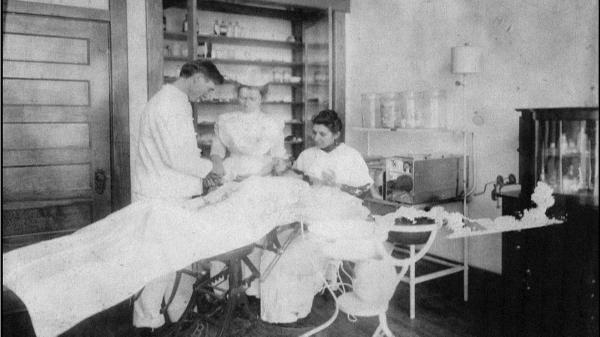
Eventually, "Dr. Sue" (left) had a small office where she performed
operations. Local Initiatives Support Corporation
“I’m not accomplishing miracles,” Susan wrote to her sisters, “but I’m beginning to see some of the results of better hygiene and health habits. And we’re losing fewer babies and fewer cases to
infection.” Doctor Sue, as she was called, believed strongly in preventative care. She worked to pass on what she's learned to aid her people in protecting themselves against diseases introduced by whites. She explained how insects carried disease. She preached against sharing drinking cups to stop the spread of tuberculosis. And
she warned against drinking alcohol. As we now know, alcoholism is a serious disease that doctor's orders rarely cure. Susan's husband Henry Picotte, a Sioux from Yankton, S.D., died of tuberculosis exacerbated by alcoholism when the couple's two boys were young.
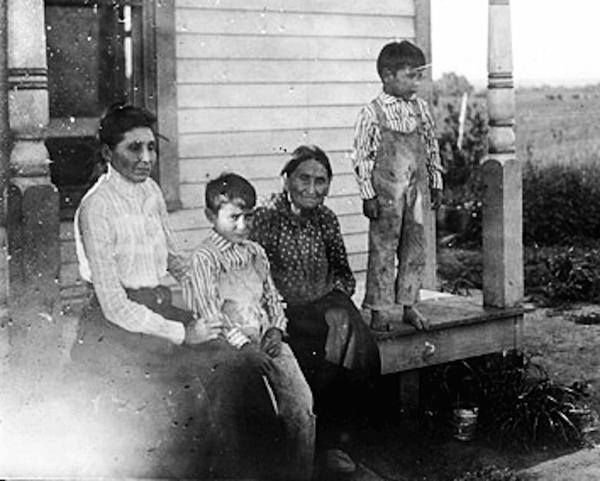
Susan La Flesche Picotte, sons Caryl & Pierre and Susan's mother, Mary Gale La
Flesche. The Picotte Center. As a single mom, caring for her elderly mother, Susan grappled with troubles women still find difficult today. She soldiered on, part social worker, friend and healer, giving her people hope when sometimes hope was in very short supply. Some credit her major force in the survival of the Omaha Nation. The small pox epidemic in the early 1800s
nearly decimated the Omaha tribe, reducing it from roughly 3000 people to 300. By Susan's time, a century later it had rebounded to roughly 1200. Today 5000 tribal members are enrolled in the Omaha Nation. Each August during the first full moon, the Omahas hold a
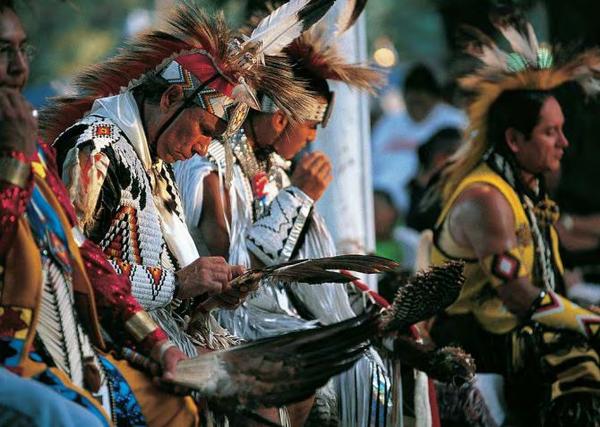
festival and celebrate the harvest the same way they have for who-knows-how-many hundreds of years.
On her house calls, Susan shared the tribe’s traditional customs, songs, stories and dances she had learned as a child. In her last
years of life dedicated herself to one more dream. Susan wanted a modern hospital on the Omaha Reservation and she undertook the project with a strong statement of Indian self-determination. The small hospital was built and outfitted with modern equipment--without a single dollar from the federal government or from the white women's organizations that offered help on
the reservation. The hospital opened in 1913, though by that time Susan was not longer practicing medicine. Her own health had deteriorated, in a large part due to the 20-hour days she had worked for ten years. She died in 1915 at the age of 50 after spending most of her too-brief life tirelessly and selflessly serving the Omaha people. I can close with no better words than those expressed by Biographer Joe Starita. “Susan La Flesche understood that the purpose of life was not to try and avoid pain and suffering. That was hopeless.... [Rather, she] believed that the purpose
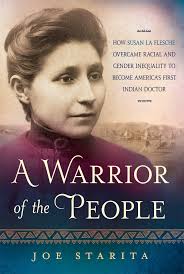
of life was to find a purpose, and then to find the courage to live out that purpose." You can buy the biography here, Joe Starita donates all royalties from this book to a college scholarship fund he has established for Native American high
school graduates.
Sources https://en.wikipedia.org/wiki/Susan_La_Flesche_Picotte https://web.archive.org/web/20200721153826/http://cojmc.unl.edu/nativedaughters/healers/susan-la-flesches-legacy-lives-on
Follow me on social media
This newsletter is a reader-supported publication. To support my work, consider becoming a paid subscriber.
Read
a great book? Have a burning question? Let me know. If you know someone who might enjoy my newsletter or books, please forward this e-mail. I will never spam you or sell your email address, you can unsubscribe anytime at the link below. To find out more about my books, how I help students, teachers, librarians and writers visit my website at www.MaryCronkFarrell.com. Contact me at [email protected]. Click here to subscribe to this newsletter. |
|
|