May 29, 2026 Hello , I remember two things from Home Ec: sewing my prom dress and learning to arrange sandwiches on a plate. The first was indeed economical, but my brain could not expand enough to understand the concept of arranging sandwiches. I ate sandwiches from my school lunch box or standing at the counter after licking the PB & J from
the knife. Today, people laugh at the idea of Home Ec, but it was founded as a scientific discipline. Early leaders in the field believed chemistry, physics, biology and other sciences could improve the quality of ordinary life for homemakers and mothers. One woman in
particular, not only believed this, she made it happen IRL. ("In real life", if you're not up text-speak) Flemmie Pansy Kittrell became the first American Black woman to receive a doctorate in nutrition, which she did at Cornell University in 1936. She was in
fact, the first woman to earn a PhD from Cornell in any subject. Though never a mother, Flemmie Kittrell helped raise more than 38 million children in the US, after the federal government based the Head Start program on her research.
Flemmie Kittrell and the Power of Home Ec
Dr. Kittrell's, parents were sharecroppers near the Virginia-North Carolina border. Her grandparents had been born enslaved. She'd been raised with the idea she'd go to college, but when a high school teacher suggested she study Home Ec, Flemmie was not
enthusiastic. "I didn't have a good reason," Flemmie said later, "except I thought the home was just so ordinary. You know all about it anyway." She had a pretty good basis for that belief, after starting work as a
nursemaid at age 11 and expanding to cooking and housekeeping throughout high school and college. But the idea of using scientific principles to solve everyday people's problems intrigued Flemmie. Then her sister died from the deficiency of one vitamin and the science of nutrition suddenly seemed
extraordinary.
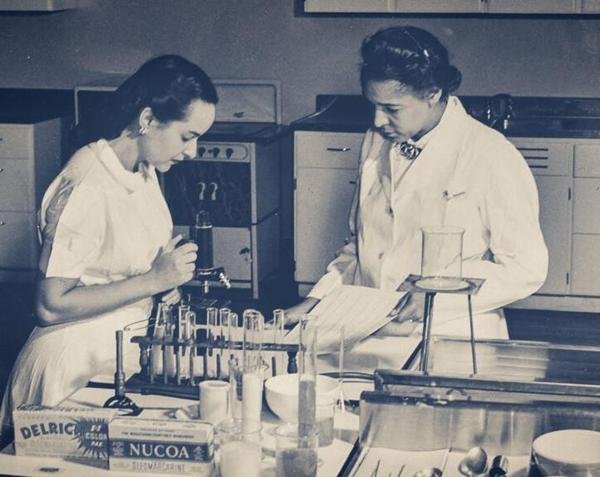
Dr. Flemmie Kittrell (right), Chair of Howard University Home Economics Department with a research
assistant in Kittrell's university lab. Photo courtesy Cornell University alumni magazine. Flemmie would one day call herself a "citizen of the world," visiting foreign countries to address global hunger, assist in US diplomacy with emerging nations, and lobby for women’s rights and education. But she was born in humble circumstances on Christmas Day, 1904, the eighth of nine children. The Kittrells lived in a four-room house with no electricity or indoor plumbing in Henderson North Carolina, where they farmed their rented land for a share of the profits. Adults and kids must have been tired at the end of the day, but Flammie's father had a habit of reading stories and poems to his children in the evenings. Her parents pushed the value of education, and following the example of two older siblings, Flemmie entered Hampton Institute, now Hampton University, a historically Black university in southeastern Virginia at age 15. She completed high school and college there, earning her B.S. in Home Economics in 1928, then went to Cornell for graduate work where she earned her masters and PhD in home economics in 1936, one of only four hundred women in the whole country to get a doctorate that year.
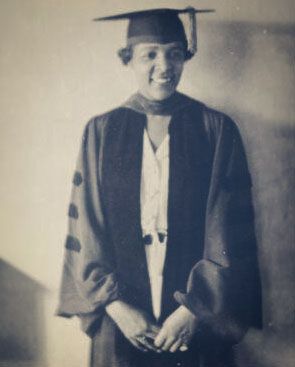
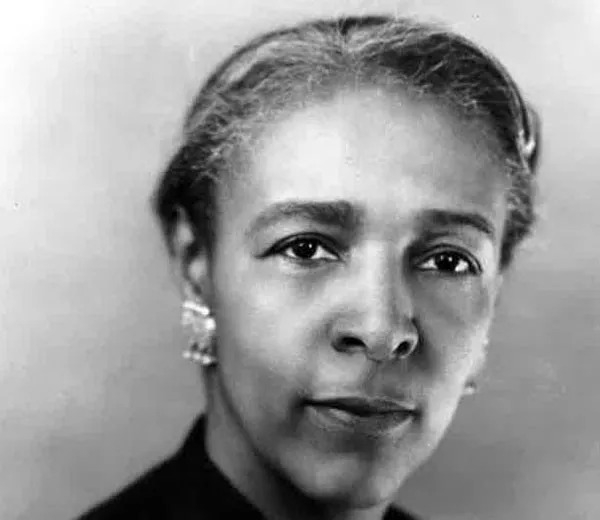
Flemmie Pansy Kittrell PhD in academic regalia, 1936. Courtesy Schlesinger Library, Harvard Radcliffe Institute. Flemmie must have faced challenges at every turn,
being a woman and Black in higher education in the 1930s. Born in the Jim Crow south she was embedded in segregation and racism, the ramifications often unseen or ignored. For instance, the disease pellagra spread death across the southern states in the early 20th Century, common among poor Blacks who lived on a diet of salt pork, corn meal, and molasses. People eating limited types of food like this got sick due to niacin (vitamin B3) deficiency. Symptoms include rough, scaly skin and sores. People also developed mental confusion, lethargy, and tremors. Left untreated, pellagra can be fatal, which is what happened to Flemmie’s sister, Mabel, who died of disease at age 22. The injustice of racism and sexism did not deter Flemmie, who knew her home economics education could help people live better lives. She didn't publicly mention Mabel's death, but it was shortly after that she took a sharpened interest in vitamins and nutrition.
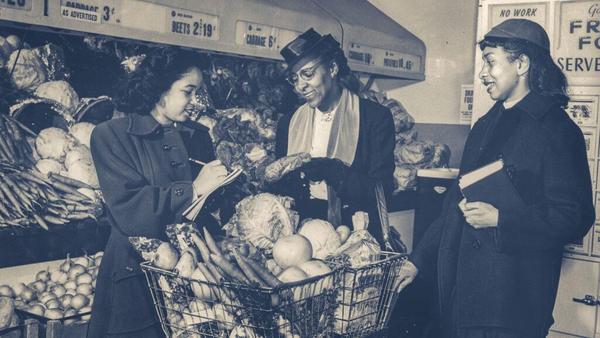
Dr. Flemmie Kittrell (center) chats with shoppers in a Washington, DC, grocery
store. Photo courtesy Cornell University alumni magazine. As an undergrad, she studied the health and well-being of poor black children. Then doctorate in hand, she set up extremely unusual research labs—nursery schools! Equipped with two-way glass and permission from parents Flemmie started conducting a radical experiment. By closely observing the preschoolers and taking extensive notes, Flemmie developed the art and science of raising children.
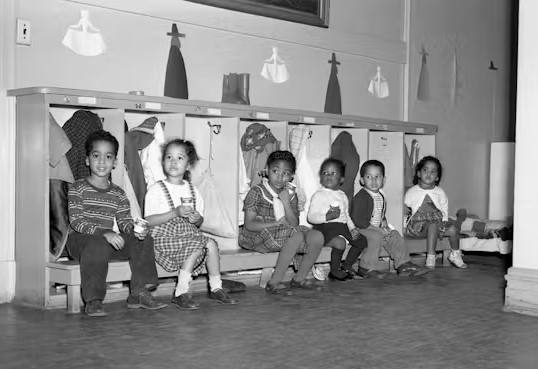
This Howard University preschool program that Kittrell helped pilot became a model for Head Start.
Moorland-Spingarn Research Center, Howard University Archives Over a number of years, Flemmie set up three nursery school research labs, first
at Bennett College in North Carolina, then at Hampton, and then in the 40s, at Howard University in Washington D.C. Every part of this nursery was meticulously planned,
according to Danya Abdelhameid of the Lost Women of Science podcast. The children were fed nutritious, homemade meals – cooked and planned by students in the Home Economics Department, of course. The nursery was bright. It had books, puzzles, a terrarium, swings, and a slide. And the children got check ups from doctors and nurses at Howard’s Medical
School.
Students said Dr. Kittrell was very serious. She had rules for you the nursery staff should treat the children. Give them eye contact. Give them hugs. Smile at them.
"I think that in working with children, this is very evident, that if you smile at a child or have a pleasant face at a child, he will eventually come your way. So that looks like I could be a good kidnapper, doesn't it?" Flemmie said with a
laugh. Her first laboratory nursery was located at Howard University, where many of the children came from well-off families, but Flemmie wanted to
discover what excellent childcare could do for poor kids. She had questions. Could it close the academic gap with more privileged students? And in the long run, could it change their lives? In 1964, her team recruited children from mostly poor Black neighborhoods near Howard. Home economics students went door to door talking to parents and signing up 3 years old research subjects. An experimental group was formed of 38 children and a similar cohort of sixty 3 year-olds did not attend the special nursery. “I didn’t have time to get married or have a family of my own,” Dr. Kittrell once told her niece, Flemmie Kittrell-Williams. “My work—that’s my children. The children of the world. And just like I would do with any other family, I do for them, with all my heart and my time.” In the 1960s, 1 in 5 American children lived in poverty. US President Lyndon B. Johnson addressed this problem, announcing his "War on Poverty." Part of that program, Project Head Start made use of Dr. Kittrell's research. She helped produce the curriculum and trained some 2,000 Head Start teachers and staff.
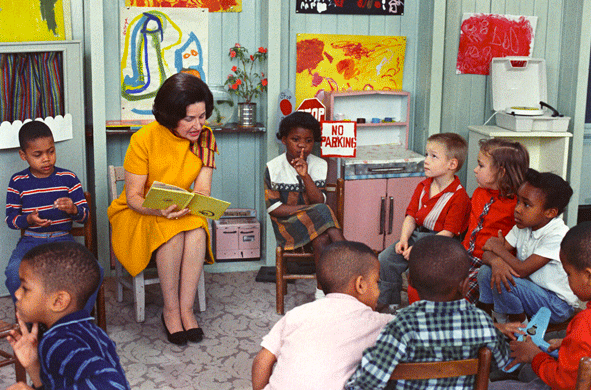
Lady Bird Johnson, the First Lady, reading to children enrolled in Project Head Start at Kemper School
in Washington, DC. White House Photograph Office, 1966. During Dr. Kittrell's tenure, Howard University became known throughout the world as a leader in
nutrition and child development. There were studies, claims, and arguments that the benefits of this type of early childhood care didn't last past the 3rd or 4th grade. And I could write on about flawed studies and non-cognitive effects that increased high school and even collage graduation rates. But Flemmie Kittrell wasn't listening to criticism and she wasn't sitting still. She persuaded leaders in Washington D.C. that home economics could make a real impact both at home and abroad. In 1947, the State Department sent her to Liberia to study nutrition as part of a broader effort to build relationships overseas.
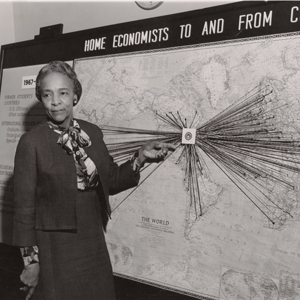
In 1968, Flemmie Kittrell points to a map showing Cornell home economists’ influence
across the globe. Photo courtesy of the Cornell Rare and Manuscript Collections.
She was not just an observer. Her research dug into families' diets in Western Africa and India and other countries, drawing international attention to
"hidden hunger," meaning a condition people suffer when they have enough food to eat, but lack the variety of food that would provide the vitamins and minerals they need to be stay healthy. Dr. Kittrell spoke out, saying the US had a "moral imperative" to reduce hidden hunger around the world. "If we could ever have enough food and if people are properly fed, we can prevent wars," she
said."
The
pastor at Dr. Flemmie Kittrell's eulogy in 1980 said of her: “Wherever … a human need was calling she was on her way to—or had just returned from—doing something about it.” Home economics doesn’t really exist as it did in Flemmie’s lifetime, but her holistic approach to early childhood education would be familiar to most parents today. Unfortunately, the Head Start Program is on the Trump administration chopping block. It's unclear how deep the cuts will go, but they could potentially eliminate the program altogether.
Like my article today? Forward this email to share with family and friends.
Though Dr. Flemmie Kittrell's work often dealt with bureaucracy, she didn't get tied up in it and worked actively for justice on a number of fronts. During her undergrad studies, she measured newborn nutrition in Black families by going door to door in the Greensboro. She asked Black parents to log what they fed their babies and she included data from doctors and midwives at the local hospital. Her research revealed Black infants died at a rate nearly twice that of white infants. Continuing to compare diet among Black and white Americans, she became convinced many health gaps in Black communities stemmed from discrimination in housing, jobs, and medical care—not poor choices. Working to alleviate hunger and improve health worldwide, especially in poor neighborhoods and communities of color, Flemmie wasn't afraid to step out of bounds.
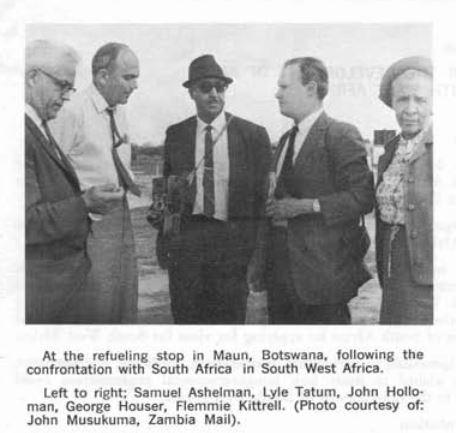
For example, she took part in an apartheid protest in 1967, that turned into a dramatic confrontation a mile high over Southwest Africa. Due to South Africa's apartheid policies and illegal occupation of the territory, the United Nations had placed Southwest Africa under its direct authority.
To test South Africa's right to administer the territory, Flemmie and four other Americans flying in two private planes tried to land in the West Africa capital without visas. They were warned not to land or "bear the consequences". Thirty
police officers stood by at the airport to arrest them if they landed. The attempted "fly-in" forced the Government of South Africa to admit in action that they did not United Nations authority in Southwest Africa.
This newsletter is a reader-supported publication. To support my work, consider becoming a paid subscriber.
Read
a great book? Have a burning question? Let me know. If you know someone who might enjoy my newsletter or books, please forward this e-mail. I will never spam you or sell your email address, you can unsubscribe anytime at the link below. To find out more about my books, how I help students, teachers, librarians and writers visit my website at www.MaryCronkFarrell.com. Contact me at [email protected]. Click here to subscribe to this newsletter. |
|
|