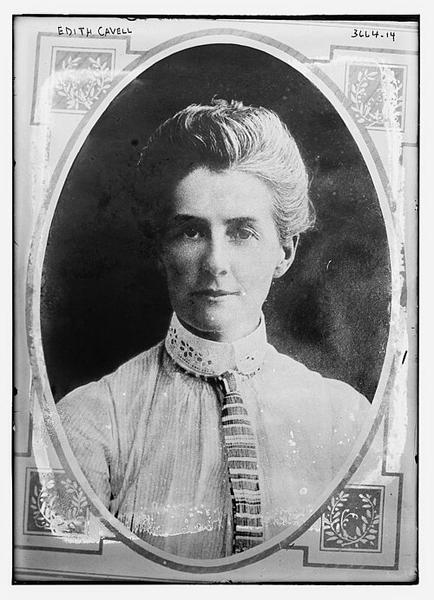
March 13, 2026 Hello , Eight shots rang out at dawn October 12, 1915, in the German-occupied city of Brussels, Belgium—the sound of a German firing squad—executing British nurse Edith Cavell. Edith had been convicted of war treason against Germany for hiding Allied soldiers and aiding their escape to the neutral Netherlands. Many of the facts of Edith's case could not be argued. She admitted to the charges in court and told her confessor she expected her sentence and believed it was just. But in the months to follow, propaganda muddled her story, turning Edith into a victim, her image used to rouse
emotion, vilify the enemy and rally troops to the battlefield. In addition, key elements of Edith's story remained a mystery and did not come to light until one hundred years after death. "The story we have always been led to
believe – of a simple nurse just doing her duty helping soldiers – turns out to have been a lot more complicated, nuanced, and dangerous than we had ever previously thought." That's according to Julian Hendy, producer of the 2015 BBC documentary that set the record straight.
The Truth Behind the Execution of Edith Cavell
At the time of her arrest, Edith Cavell was a preeminent pioneer of modern nursing who had been recruited to lead Belgium's first nursing school at the Berkendael Institute. “The old idea," she said, arriving in Brussels in 1907, "that it is a disgrace for women to work is still held in Belgium and women of good birth and education still think they lose caste by earning their own living.”
Edith Louisa Cavell Edith's goal was to “create a profession for women”, allowing “an independent life.” She had worked as a nurse for more than ten years in England before moving to Belgium and helping establish the nursing school. Shortly, Edith was responsible for training nurses at three hospitals, twenty-four schools, and thirteen kindergartens across Belgium. To support her nurses, she launched the professional nursing journal L'infirmière and in 1910 she was Edith was invited to be the matron for the new secular hospital at Saint-Gilles. Her reputation for excellence was so well known, that when the Queen of Belgium broke her
arm, she requested a Cavell-trained nurse.
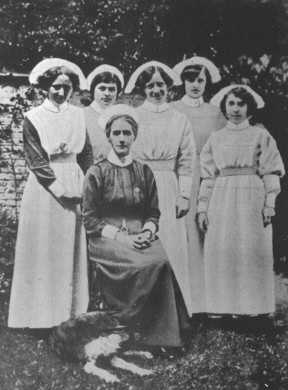
Edith Cavell with some of her nurses in Brussels. At the start of war on July 28, 1914, Edith was back in England, visiting her mother in the family home in Norfolk. But she returned to Brussels that week. “At a time like this,” she announced, “I am more needed than ever.” Days later, German troops marched into Belgium triggering the first battle of
the war. The Red Cross took over the Berkendael Institute and Edith Cavell took charge of caring for the insured soldiers brought from both sides of the frontline. English, French, German or Austrian, she instructed they all receive the best care they could be given in her hospital. Numbers of civilians caught in the battle also needed treatment. When Brussels fell under German control, the city became dangerous enemy territory. Soldiers combed the streets for English and French soldiers, even targeting Belgium men of fighting age. Posters throughout the city warned: "Any male or female who
hides an English or French soldier in his house shall be severely punished.” Edith ignored the posters. She became helped form an underground network that provided refuge, money, food and guides for the men who needed to escape for their lives. Patriotism was not Edith's prime motivation. She committed herself to protecting human life, even at the risk of her own. For almost a year, Edith helped some 200 men get away to the Netherlands. The network drew German suspicion, but there was not enough evidence against Edith until a Frenchman, Georges Gaston Quien, seeking his own freedom from the
Germans, went to the hospital pretending to be a soldier needing escape. He betrayed her and the others. The German army arrested Edith in early August, 1915, claiming she was part of an espionage ring. This was vehemently denied by the British Government. Edith
spent ten weeks in prison, the last two in solitary confinement, waiting for her trial. Edith wrote “I have no fear nor shrinking…life has always been hurried and full of difficulty. This time of rest has been a great mercy." At her court-martial, Edith was sentenced to death, and the German's moved quickly to execute her despite
pleas for a reprieve from US and Spanish diplomats. The British Foreign Office claimed to be “powerless” to save her life. The German military governor of Belgium General Moritz Von Bissing signed the warrant for her execution. "This
Cavell woman," he said, "had guilty knowledge of much of their [espionage] work. Such a system of spying assails our very safety and we proceeded to stamp it out."
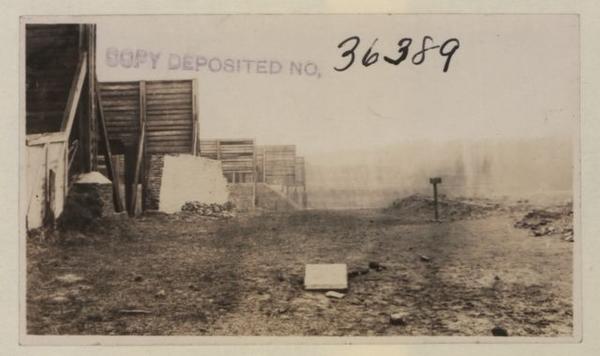
The site where Miss Cavell was shot by the Germans, British Library Digital Collections
Preparing for her execution, Edith wrote “I want you to know I am neither afraid nor unhappy, but quite ready to
give my life for England.” She amended these words a little later speaking to an Anglican chaplain during her final communion. "Standing as I do in view of God and eternity, I realize that patriotism is not enough. I must have no hatred
or bitterness towards anyone.” Edith's execution made newspapers headlines throughout Europe and North America. As a non-combatant, and a woman, her stoicism in
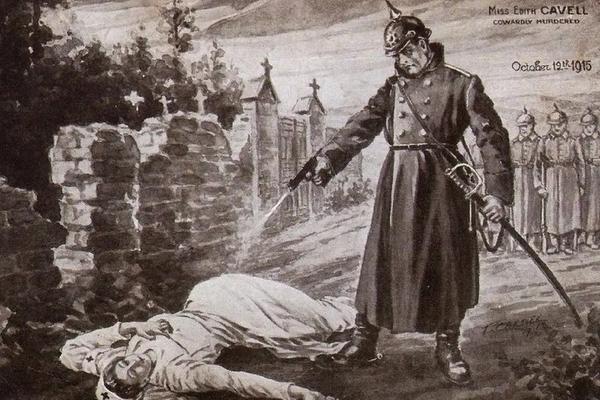
the face of death seemed incredible to many and brought her more distinction than would have been given a man in her place. Other stories somewhat obscured the woman Edith was. The American Journal of Nursing reprinted a fiction going around that Edith had refused to wear a blindfold for her execution and fainted. The false story said that as she lay unconscious, the German commanding officer shot her dead with a pistol.
Early news reports, which inspired a number of propaganda postcards, incorrectly said Edith Cavell had
fainted after refusing to wear a blindfold at her execution. The British War Propaganda Bureau spread this image widely in
Britain and North America, using postcards and posters to galvanize public opinion against the Germans. Edith was often shown wearing her nursing uniform to her death, though she had made a point of not wearing one because she was not convicted for being a nurse. Across the British Empire her death was used to rally patriotism and army recruits. One Canadian poster showed Edith's image labeled "Murdered by the Huns" and urged men to "Enlist in the 99th and help stop such atrocities." For two months following Edith's death, the number of soldiers signing up for military service in Britain doubled from 5,000 to 10,000 a week. Her execution was represented as an act of German barbarism and moral depravity - totally at odds with Edith's on wish to have "no
hatred or bitterness towards anyone."
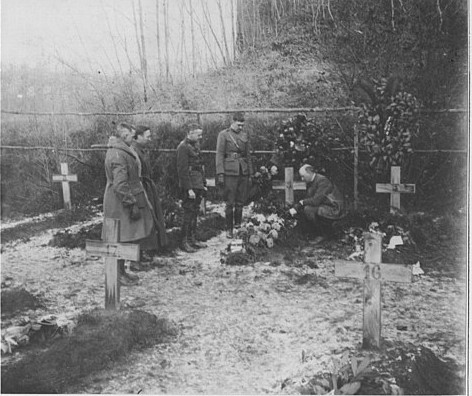
Group of American Red Cross men placing a wreath on Edith Cavell's grave immediately after the departure of the
Germans from Brussels, Belgium - NARA - 20805702.jpg After her death and in the following decades, Edith Louisa Cavill was remembered and honored with countless
memorials, statues, portraits and plaques. In Britain and beyond, her story has been told in plays, films and TV. The Church of England celebrates her feast day on October 12, which is also marked on the US Episcopal Church liturgical calendar. Two months after Edith's execution a baby born in France was named Édith after her. The name was rare in that country, but French singer Édith Piaf made it famous. And Cavill has been honored by at least a dozen musical pieces. But not until the 100th anniversary of her death, did the world learn Edith Cavell had indeed been a spy. Dame Stella Rimington, the former director-general of MI5 announced in 2015, that the Brussels network had been a two prong operation. Edith helped soldiers escape and she also helped smuggle intelligence to the Allies. Researching military archives in Belgium, Dame Stella discovered evidence that had been overlooked before. The files included an account by Herman Capiau, a young Belgian mining engineer arrested with Edith, but who escaped the death penalty and served 15 year's hard labor in a German camp. As part of the same network as Edith, Herman helped pass information to the English about a German trench system and the locations of munitions dumps and aircraft. The particulars were inked on strips of fabric and sewn into clothes, or hidden in shoes
and boots. "Whenever it was possible to send interesting intelligence on military operations," Herman wrote, "this information was
forwarded to the English intelligence service punctually and rapidly."
The newly discovered evidence also linked Edith to Dr Tollemache Bull, an Englishman who had lived in Brussels and later admitted working for Secret Service Bureau, the forerunner to MI6.
The body of Edith Cavell carried from the wharf at Dover. Her memorial service was held in Westminster Abbey, London. She was buried at Life's Green, near Norwich
Cathedral. Edith's body came home to England at the end of The Great War, conveyed with much ceremony from Dover to London. Thousands of mourners followed the funeral cortege to her memorial service in Westminster Abby. Biographer Diana Souhami, says evidence indicating Edith was involved in the espionage network helps negate the propaganda that distorted her memory. "They saw Cavell as this innocent victim....We can now see her for what she did." Edith Cavell didn't want to be remembered as a martyr or a heroine, but as “a nurse who tried to do her duty."
Like my article today? Forward this email to share with family and friends.
Sources https://edithcavell.org.uk/edith-cavells-life/
Follow me on social media
This newsletter is a reader-supported publication. To support my work, consider becoming a paid subscriber.
Read
a great book? Have a burning question? Let me know. If you know someone who might enjoy my newsletter or books, please forward this e-mail. I will never spam you or sell your email address, you can unsubscribe anytime at the link below. To find out more about my books, how I help students, teachers, librarians and writers visit my website at www.MaryCronkFarrell.com. Contact me at [email protected]. Click here to subscribe to this newsletter. |
|
|