June 5, 2026 Hello , I'm planning to!
But I just learned the extraordinary true story of a self-made scientist responsible for ground-breaking discoveries about a small octopus, the paper nautilus, Latin name Argonauta argo. Jeanne Villepreux-Power, a French dressmaker in the early 1800's
invented the aquarium out of necessity. She needed a way to observe the tiny octopus that fascinated her, as it had puzzled naturalists since the time of Aristotle. Female argonauts have a thin, beautifully corrugated shell. For centuries curious male scientists
wondered if the octopus made the shell herself.
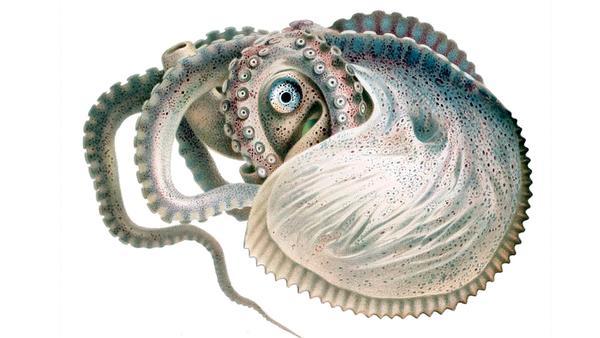
Drawing by Comingio Merculiano (1845–1915) in Jatta Giuseppem, Wikipedia. They wondered why was it shaped differently than her body? Why could she shrug off her shell and yet never left it, like other mollusks? Why did only females have this shell? They never answered these and many more questions because they studied dead, preserved
argonauts. Jeanne Villepreux-Power tried something new, and she answered all these questions, plus demonstrated the tiny sea creature used multiple intelligences to do something nobody had dreamed possible.
The Real-Life Lady and the Octopus
Jeanne Villepreux, the eldest child of a shoemaker and a seamstress, was born in 1794 in a small village in southern France. Her mother died when Jeanne was eleven. It's possible she had sewing skills by that time and was able to pick up some of her mother's work and become a proficient seamstress. For at 18, Jeanne secured a position as a dressmaker in Paris and left home to walk to the city. It was more than 250 miles from her village of
Juillac to Paris and a cousin went along to protect her. He assaulted Jeanne and left her even more vulnerable, fleeing with her identity papers. Jeanne was able to wait safely at a local police station until new copies of her travel documents arrived. She eventually arrived in Paris, but not in time. Another dressmaker had been hired. Jeanne looked for work in the city and
was hired as a seamstress assistant, then promoted to embroidery. Four years and thousands of dresses later, her skillful artistry had gained a reputation among Paris' wealthy families. Jeanne created a wedding gown for Italian princess Caroline and her marriage to Charles-Ferdinand de Bourbon, nephew of King Louis XVIII. The royal commission drew her into a world of wealth and
power, where she met and fell in love with an English merchant, married him, and moved with him to the harbor city of Messina on the island of Sicily.
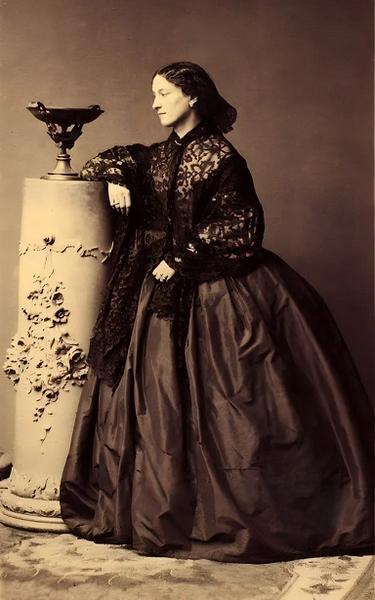
Jeanne Villepreux-Power, dressmaker to a princess and pioneering French marine biologist. A young woman who'd worked hard all her life unexpectedly found herself with "hours that remained to me free
from my domestic affairs." Walking the seashores or Sicily, wading into the water in her long skirts, she found a passion for the natural world and engrossed herself in books on geology, archeology and natural history, giving herself the only scientific education available to most women at the time. She explored her tropical island home, cataloguing it's flora and
fauna and collecting minerals, fossils, butterflies and shells. She made an inventory of Sicily's ecosystem, eventually publishing two books of her observations. The paper nautilus, named for its thin shell, captured Jeanne's fascination and intellectual curiosity. But it was extremely difficult to observe the octopus' habits and movements. Jeanne wrote: "When the air is serene, the sea calm, and she believes herself unobserved, the Argonauta adorns herself with her beauties; but I had to be
prudent enough to enjoy her rich colors and graceful pose, for this animal is very suspicious..." "As soon as it
perceives that it is being observed, it withdraws its membranes into its shell in the blink of an eye and flees to the bottom...reemerging to the surface only when it thinks it is safe from all danger." Jeanne could never satisfy her desire to learn about the
argonaut by studying dead specimens. She needed a way to observe it in its natural habitat. Over ten years, she developed three different enclosures for the study of live marine life in and out of the water. The first, an aquarium similar to what you see today; the second, glass surrounded by a case that was submerged in the ocean; the third, offshore cages with observation windows
off the Sicilian coast to which she rowed daily to watch the argonauts without disturbing them. Jeanne's methods were revolutionary for the time. She documented behavior no one had recorded before: some species of octopuses using tools to pry open the shells of their prey.
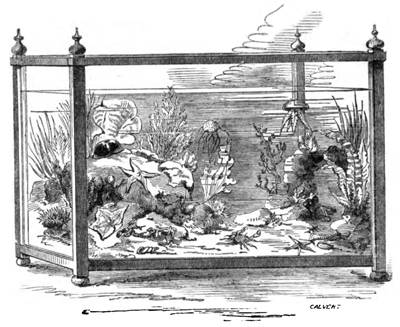
Home aquarium, circa 1860, Wikimedia Commons. At
age 40, her home a marine biology lab filled with tanks, populated with living argonauts, Jeanne started a series of innovative experiments that would break open ancient mysteries and be foundational in the study of octopus intelligence, which has forever changed our understanding of consciousness itself. Taking on the question of
how the argonaut gets its spiral shell in 1933, Jeanne acquired three pregnant females so she could observe one from birth. Each mama octopus carried thousands of eggs in its enlarged shell and Jeanne watched them hatch, visiting every six hours to study them in three hour blocks. A tiny baby octopus born naked in a gelatinous sacs moved to embrace itself, wrapping its
membranous arms around its sac, the end of which it started to fold into the shape of a spiral. Jeanne returned the baby to its mother and checked back six hours later. The tiny octopus had begun to form its shell out of a thin film, which soon thickened into the signature corrugation of the argonaut shell. She wrote: "I armed myself with patience and courage, and only after several months managed to dissolve my doubts and see my research crowned with happy confirmation." Contrary to what men in the marine biology field believed, the female argonaut
created its own shell, beginning almost at birth. Jeanne was about to discover even more exciting and groundbreaking marine science.
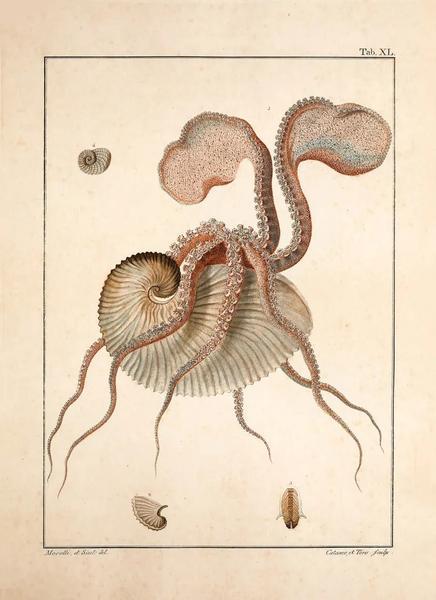
Extended morphology of a female argonaut with egg case by Giuseppe Saverio Poli. (Available as a print
and as stationery cards, benefiting The Nature Conservancy.) If an octopus could build its own shell, could it also patch up
holes? Jeanne tested this by poking a small hole in an adult female's shell. She watched in astonishment. The creature extended its
front arms with membranes looking kind of like rabbit ears (take another look at the drawing above) which scientists had previously thought helped with swimming. But no. The octopus swept its arms like a windshield wiper over the hole in its shell and sealed it with a glutenous substance that matched the original shell, though the patch was a bit thicker like a scar. Jeanne was only just beginning. For her next experiment, she broke off a small piece of an adult argonauts' shell and lay it amongst other shell fragments on the bottom of the tank. The octopus hurried toward the shell pieces, its arms feeling around for a fragment of the right fit, then plastering it over the hole in its shell, lining up the furrows of the borrowed puzzle piece with the ridges in its own shell. The arm membranes swept of the surface shellacking it in place. Jeanne repeated this experiment for five years, proving again and again that this tiny sea creature could perform tricks earlier naturalists never dreamed
possible.
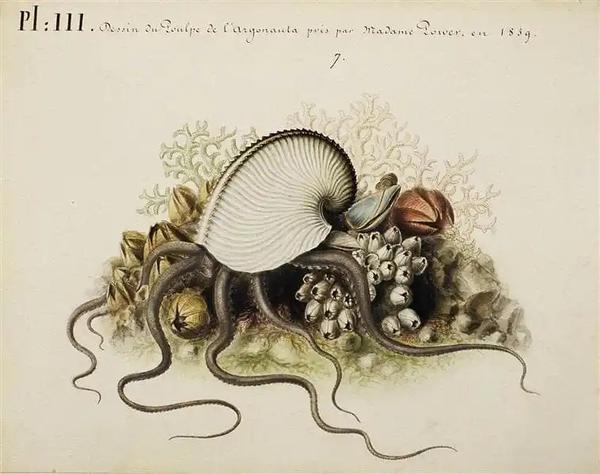
Color sketch of a paper nautilus sketch made by Jeanne Villepreux-Power in
1839. Because Jeanne was female, she wasn't allowed to publish papers about her discoveries, speak at academic conference,
or enroll at a university and continue her scientific work. The results of her experiments only became known around the world because she
had cultivated a relationship with Charles Darwin. He and a preeminent scientist, Sir Richard Owen, disseminated Jeanne's research throughout Europe. It was translated into German, French, and English. In addition to her study of the paper nautilus, Jeanne pioneered aquaculture in an effort to safeguard and restore marine animal populations. She was the first to develop sustainable aquaculture in Sicily. Jeanne Villepreux-Power and her husband moved from Sicily to new residences in London and Paris. Unfortunately, on one voyage from Sicily in 1846, her marine collections, written records, and other scientific materials were lost in a shipwreck. In 1997, a crater on Venus discovered by the Magellan probe was named Villepreux-Power to honor this incredible woman who started life as a simple tradeswoman with little education and ended up a pioneer in marine science and inventing the
aquarium, now familiar to even the youngest children in the developed world.
Here's something different! Octopus Poetry (Click title for complete poem) The Age of the Possible by Maria Popova .... A blink of time ago
we thought the octopus
impossible,
we thought this blue world
lifeless
below three hundred fathoms
until in 1898
—
an epoch after Bach
scribbled in the margin
of a composition
“Everything that is possible is real” —
we plunged our prosthetic eye
deep into the
blue
and found a universe of life.
Octopus Empire by
Marilyn Nelson
...Now scientists have found
a group of octopuses
who seem to have a sense
of community, who
live in dwellings made of
gathered pebbles and shells,
who cooperate, who
defend an apparent
border. Perhaps they’ll have
a plan for the planet
in a millennium
or two. After we’re gone.
Like my article today? Forward this email to share with family and friends. 84-year-old Haddonfield High home economics teacher is retiring. No one will take her place.
84-year-old Haddonfield High home economics teacher is retiring. No one will take her place. Growing up in the 1950s, Arleen Iavicoli set her sights on becoming a doctor. But that was frowned upon as a suitable career choice for a young woman. Instead, Iavicoli decided to become a teacher, and she loved it. She found her niche teaching culinary arts and life skills at Haddonfield Memorial High School for more than two decades. A popular and beloved educator, Arleen is retiring at the end of the school year. No one will take her place.
|
|
|
|
This newsletter is a reader-supported publication. To support my work, consider becoming a paid subscriber.
Read
a great book? Have a burning question? Let me know. If you know someone who might enjoy my newsletter or books, please forward this e-mail. I will never spam you or sell your email address, you can unsubscribe anytime at the link below. To find out more about my books, how I help students, teachers, librarians and writers visit my website at www.MaryCronkFarrell.com. Contact me at [email protected]. Click here to subscribe to this newsletter. |
|
|